After a car accident, you might recall the other driver looking down, a phone in their hand, just moments before impact. If that gut feeling is right, you've been a victim of distracted driving, and the consequences can be devastating.
At Oakes Firm, we understand the profound impact a serious personal injury has on your life. The physical pain, the emotional distress, the mounting medical bills, and the lost wages can quickly become overwhelming.
When someone else's reckless decision to prioritize a phone call or a text over your safety causes your injuries, it's not just an accident, it's a profound injustice.
We are true fighters for our clients' legal rights, and we are here to aggressively advocate for you and secure full settlements.
This is not a fight you should face alone. Especially in Philadelphia, where our roads are bustling and distractions are rampant, holding negligent drivers accountable is paramount. We can relentlessly pursue justice on your behalf.
Contact a dedicated car accident lawyer at Oakes Firm today for a free consultation.
Schedule A Free Case Consultation
Key Takeaways
- As of June 5, 2025, Paul Miller's Law makes it a primary offense to use a hand-held mobile device while driving in Pennsylvania.
- Violating this law can serve as powerful evidence of negligence (negligence per se) in a personal injury claim.
- Evidence like cell phone records, witness statements, and traffic camera footage helps prove the other driver was distracted.
- Victims may recover damages for medical bills, lost wages, property damage, and pain and suffering.
The Clear Danger of Distracted Driving in Pennsylvania
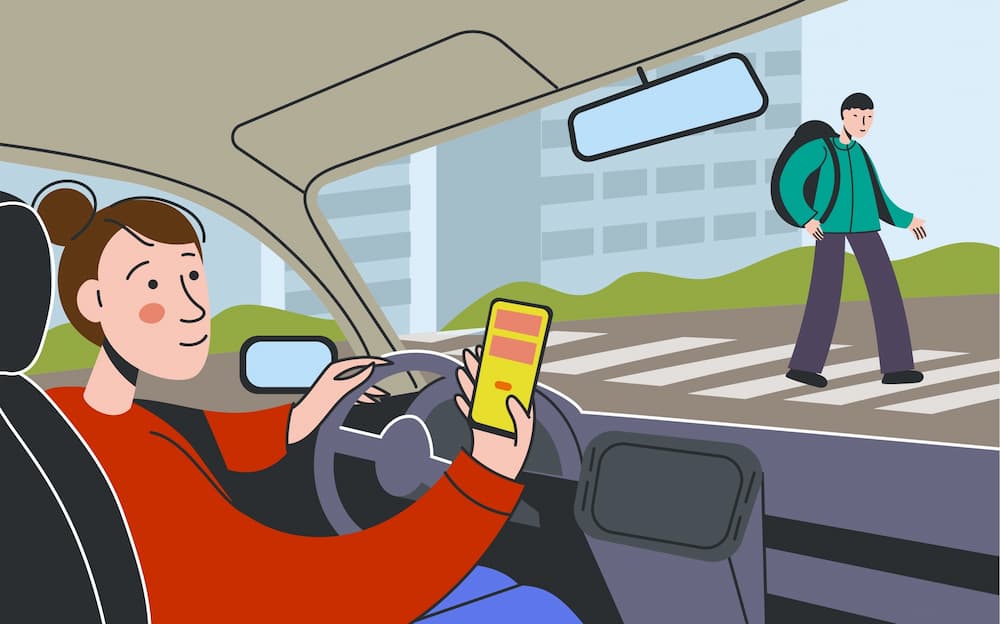
Distracted driving is a menace on our roads. It encompasses any activity that diverts a driver's attention from the primary task of driving, including:
- Manual Distractions: Taking your hands off the wheel (e.g., reaching for a phone, eating).
- Visual Distractions: Taking your eyes off the road (e.g., looking at a phone screen, reading a map).
- Cognitive Distractions: Taking your mind off driving (e.g., engaging in an intense phone conversation, daydreaming).
Using a mobile phone for anything other than a hands-free conversation falls into all three categories, making it one of the most dangerous forms of distracted driving. Pennsylvania has taken significant steps to combat this.
Paul Miller's Law
Effective June 5, 2025, Pennsylvania enacted Paul Miller's Law, making it a primary offense for any driver to use a hand-held interactive mobile device while operating a motor vehicle. This law is a direct response to the tragic consequences of distracted driving and provides a clearer path to justice for victims.
- No Holding a Phone While Driving: It is now explicitly illegal to hold a mobile device in your hand for any purpose while your vehicle is in motion. This includes simply holding it, dialing, or answering by pressing more than a single button.
- Even at a Stop: The ban applies even when your vehicle is temporarily stopped at a traffic light, stop sign, or in traffic. To use a hand-held device legally, you must pull your vehicle safely off the highway and come to a complete stop.
- Emergency Exception: There's an exception for communicating with law enforcement or emergency services to prevent injury to persons or property.
- Texting While Driving Ban Still in Effect: This new law complements Pennsylvania's existing texting-while-driving ban, which prohibits sending, reading, or writing text-based communications while the vehicle is in motion.
While the immediate penalty for violating Paul Miller's Law is a written warning for the first year (effective June 5, 2026, it becomes a $50 fine plus court costs), the true power of this law lies in its implications for personal injury claims.
Proving Negligence: The Cornerstone of Your Claim
In Pennsylvania, to recover damages after a car accident, you generally need to prove that the other driver was negligent. Negligence means that the other driver failed to exercise reasonable care, and this failure directly caused your injuries.
When the other driver was on their phone during the crash, it provides powerful evidence of their negligence. Here's why:
- Breach of Duty: All drivers owe a duty of care to operate their vehicles safely and avoid causing harm to others. Using a phone while driving, especially in violation of Paul Miller's Law, is a clear breach of this duty.
- Negligence Per Se: Paul Miller's Law is a safety statute. In Pennsylvania, if someone violates a statute designed to protect public safety, and that violation causes an injury, it can establish negligence per se. This means their negligence is presumed, making it significantly easier to prove fault in your personal injury claim. You don't have to prove they were generally careless; the fact that they violated the law is strong evidence of their negligence.
- Causation: The violation of the distracted driving law directly links their actions to your accident and injuries. Their distracted state directly led to their inability to react safely or properly control their vehicle.
Gathering Evidence
Proving the other driver was on their phone can be challenging, but an experienced personal injury attorney knows how to uncover the crucial evidence. We leave no stone unturned in our relentless pursuit of justice.
Our strategies include:
- Police Reports: The police report is often the first official document of the accident. It may include observations by the responding officer about the other driver's behavior or admissions of phone use.
- Witness Statements: Eyewitnesses are invaluable. If anyone saw the other driver on their phone, their testimony can be incredibly powerful. We will work to identify and interview any potential witnesses.
- Cell Phone Records: This is often the most direct evidence. Through legal channels, we can request the other driver's phone records to determine if they were actively using their device at or immediately before the time of the crash.
- Traffic Camera Footage/Dashcam Footage: Surveillance cameras from nearby businesses, traffic cameras, or even dashcams from other vehicles might have captured the moments leading up to the accident, showing the other driver's distracted behavior.
- Driver Admissions: Sometimes, a distracted driver might admit to being on their phone at the scene. It's important to report such admissions to the police.
- Forensic Reconstruction: In complex cases, accident reconstruction experts can analyze the scene, vehicle damage, and other data to determine how the accident occurred and if distracted driving was a contributing factor.
Understanding Damages
A serious personal injury caused by a distracted driver can result in a wide range of losses. In Pennsylvania, you may be entitled to recover both economic and non-economic damages. At Oakes Firm, our goal is to secure maximum compensation.
Economic Damages
- Medical Bills: This includes all past, present, and future medical expenses related to your injuries, such as emergency room visits, hospital stays, surgeries, doctor's appointments, physical therapy, prescription medications, and medical devices.
- Lost Wages: Compensation for income you've lost due to your inability to work after the accident.
- Loss of Earning Capacity: If your injuries permanently affect your ability to earn a living or return to your previous profession, you can seek damages for future lost earning potential.
- Property Damage: Costs to repair or replace your vehicle and any other personal property damaged in the crash.
- Other Out-of-Pocket Expenses: This can include transportation to medical appointments, childcare costs if you're unable to care for your children due to injuries, and other directly related expenses.
Non-Economic Damages
These are often more challenging to quantify but are crucial for full compensation. They reflect the profound impact the accident has had on your life beyond financial losses.
- Pain and Suffering: Compensation for the physical pain and discomfort you've endured, both immediately after the accident and on an ongoing basis.
- Emotional Distress: This includes anxiety, depression, PTSD, and other psychological impacts resulting from the trauma of the accident and your injuries.
- Loss of Enjoyment of Life: If your injuries prevent you from participating in hobbies, activities, or aspects of life you once enjoyed, you can seek compensation for this loss.
- Scarring and Disfigurement: If your injuries result in permanent scarring or disfigurement, you may be compensated for the emotional and social impact.
- Loss of Consortium: If your injuries have severely impacted your relationship with your spouse, your spouse may have a claim for loss of consortium.
Punitive Damages
In rare cases where the other driver's conduct was particularly egregious punitive damages may be awarded. These are not intended to compensate the victim but rather to punish the wrongdoer and deter similar behavior in the future. Distracted driving, especially if it was a severe and intentional disregard for safety, could potentially lead to punitive damages.
Schedule A Free Case Consultation
Pennsylvania's Unique Insurance and Negligence Laws
Understanding Pennsylvania's specific laws is critical for any car accident claim.
- Modified Comparative Negligence (51% Rule): Pennsylvania follows a modified comparative negligence rule. This means that if you are found to be partially at fault for the accident, your recoverable damages will be reduced by your percentage of fault. However, if you are found to be more than 50% at fault, you are barred from recovering any damages. This is why having an aggressive attorney who can clearly establish the other driver's fault, especially in distracted driving cases, is so important.
- Choice No-Fault System: Pennsylvania is a choice no-fault state. When you purchase car insurance, you choose between full tort and "limited tort" coverage.
- Full Tort: If you have full tort coverage, you retain your right to sue the at-fault driver for all damages, including pain and suffering, regardless of the severity of your injuries.
- Limited Tort: If you choose limited tort, your ability to sue for non-economic damages like pain and suffering is restricted unless your injuries meet a "serious injury" threshold. However, even with limited tort, you can still recover for economic damages. Our attorneys can help you understand the implications of your tort option and how it impacts your claim.
- Uninsured/Underinsured Motorist (UM/UIM) Coverage: This is vital coverage that protects you if the at-fault driver has no insurance (UM) or insufficient insurance (UIM) to cover your damages. We strongly advise our clients to carry robust UM/UIM coverage, as the minimum liability limits in Pennsylvania ($15,000 per person/$30,000 per accident) are often inadequate for serious injuries. If you have UM/UIM coverage, our firm can help you pursue a claim against your own insurance company to ensure you receive full compensation.
Why You Need a Philadelphia Car Accident Lawyer
The immediate aftermath of a car accident is chaotic. You're dealing with injuries, pain, vehicle damage, and the stress of daily life. The last thing you need is to deal with the legal system and battle aggressive insurance companies on your own.
This is where Oakes Firm steps in. We are not just attorneys; we are relentless advocates who understand what you're going through.
- Experience in Distracted Driving Cases: We are acutely aware of the nuances of Pennsylvania's distracted driving laws, including Paul Miller's Law, and how to leverage them to prove negligence and maximize your compensation.
- Investigative Prowess: Our team has the experience and resources to meticulously investigate your accident, gather crucial evidence like cell phone records and witness statements, and build a compelling case.
- Dealing with Insurance Companies: Insurance companies are in the business of minimizing payouts. They will try to undermine your claim, dispute your injuries, or even shift blame to you. We know their tactics and will aggressively negotiate on your behalf to ensure you receive a fair settlement. If they refuse to offer what your case is truly worth, we are fully prepared to take your case to trial.
- Valuing Your Claim Accurately: We work with medical professionals, economists, and other experts to accurately assess the full extent of your damages, including future medical needs and lost earning capacity.
- Personal Attention and Compassion: While we are aggressive in the courtroom and at the negotiating table, we are always compassionate and caring with our clients. We know this is a difficult time, and we strive to make things easy for you, lifting the additional stress off your shoulders. We will always keep you updated on your case and take your calls, ensuring you receive the personal attention you deserve.
- Proven Results: Thomas G. Oakes II has been recognized as a Super Lawyers Rising Star (2018-2025), a National Academy of Personal Injury Attorneys "Top 10 Under 40" (PA, 2019-2023), and The National Trial Lawyers "Top 40 Under 40" (Civil Attorney, 2023). These accolades are a testament to our firm's experience, knowledge, and dedication to securing countless millions of dollars for our clients.
FAQs About Distracted Driving
What if the driver who hit me was using a hands-free device?
Even if a driver uses a hands-free device, they may still be negligent. The key question is whether the conversation or activity distracted them from the primary task of driving safely. Engaging in an intense or emotional conversation, even hands-free, constitutes cognitive distraction and serves as evidence of their failure to exercise reasonable care.
The police report for my accident doesn’t say the other driver was on their phone. Can I still make a claim?
Yes. A police report is just one piece of evidence. Officers arrive after the fact and may not see or record every detail. We frequently investigate cases where we uncover evidence of phone use that was not included in the initial report. This involves subpoenaing phone records, finding witnesses, and analyzing other available data.
How long will it take to resolve my car accident case?
The timeline for a car accident claim varies significantly based on several factors: the severity of your injuries, the complexity of the evidence, and the willingness of the insurance company to negotiate fairly.
We prioritize moving your case forward efficiently while never sacrificing the detail required to build a strong claim.
Don't Wait – Protect Your Rights
The statute of limitations for most personal injury claims in Pennsylvania is two years from the date of the accident. While this may seem like a long time, crucial evidence can disappear, and memories can fade. The sooner you act, the stronger your case will be.
If you believe the other driver was on their phone during a crash that left you injured, you have a right to seek justice and full compensation. You need a legal team that is very professional and aggressive to get the best care and maximum penalty payout.
Our compassionate attorneys are ready to fight for your rights, your well-being, and for maximum compensation. We will guide you from start to finish, including negotiating medical bills and dealing with insurance, so you can focus on your recovery. Let us be your fighter in securing the justice you're owed.
Contact Oakes Firm today at (267) 310-0656 for a free consultation.