The pain started gradually. Maybe tingling in your fingers after a long shift, stiffness in your wrist that you shook off, or an ache in your elbow that you blamed on sleeping wrong. Then it got worse.
Now you're facing surgery, months of recovery, and the possibility that you'll never work the same way again. A repetitive stress injury lawsuit in Philadelphia may allow you to recover compensation from third parties whose defective products or negligent services contributed to your condition—damages that go far beyond what workers' compensation provides.
Repetitive stress injuries develop over time from repeated motions, awkward postures, and sustained force. They're real injuries with real consequences: chronic pain, nerve damage, lost income, and careers cut short.
Pennsylvania workers' compensation covers many RSIs, but workers' comp benefits are limited. When a third party's negligence contributed to your injury—a defective keyboard, poorly designed tool, or equipment manufacturer who ignored ergonomic principles—you may have additional legal options.
Reach out to a Philadelphia workplace accident lawyer today to find out whether your carpal tunnel or repetitive stress injury claim allows you to recover compensation beyond workers’ compensation.
Schedule A Free Case Consultation
At a Glance
- Repetitive stress injuries include carpal tunnel syndrome, tendonitis, bursitis, trigger finger, and other conditions caused by repeated workplace motions
- Pennsylvania workers' compensation covers RSIs as occupational diseases, though proving work-relatedness can be more complex than with sudden injuries
- Third-party liability for RSIs may exist when defective equipment, poorly designed tools, or negligent ergonomic consultants contributed to the condition
- Carpal tunnel syndrome workers' comp claims require medical evidence linking the condition to specific job duties
- RSI lawsuits against equipment manufacturers use product liability theories including design defect and failure to warn

What Qualifies as a Repetitive Stress Injury?
Repetitive stress injuries—also called repetitive strain injuries, cumulative trauma disorders, or overuse injuries—develop when the same motions, postures, or forces stress tissues faster than the body can repair them. Unlike a broken bone from a fall, these injuries build gradually until pain and dysfunction become impossible to ignore.
Carpal Tunnel Syndrome
Carpal tunnel syndrome occurs when the median nerve gets compressed as it passes through the narrow carpal tunnel in your wrist. Repeated wrist flexion, gripping, and vibration exposure cause the tendons in this space to swell, squeezing the nerve and producing numbness, tingling, weakness, and pain in the thumb, index, middle, and ring fingers.
Assembly line workers, cashiers, office workers who type extensively, and anyone using vibrating tools faces elevated carpal tunnel risk. Without treatment, the nerve damage can become permanent, leading to muscle wasting in the hand and chronic disability.
Tendonitis
Tendonitis involves inflammation of the tendons—the fibrous cords connecting muscle to bone. It commonly affects the wrist (De Quervain's tendonitis), elbow (lateral epicondylitis or "tennis elbow," medial epicondylitis or "golfer's elbow"), shoulder (rotator cuff tendonitis), and Achilles tendon.
Workers who perform repetitive gripping, lifting, reaching, or twisting motions develop tendonitis when their tendons can't recover between shifts. The condition causes pain, swelling, and reduced range of motion that worsens without rest and treatment.
Bursitis
Bursae are small fluid-filled sacs that cushion joints. Repetitive pressure or motion can inflame these sacs, causing bursitis. The condition commonly affects shoulders, elbows, hips, and knees.
Workers who kneel frequently (carpet layers, tile setters), reach overhead repeatedly (painters, electricians), or perform repetitive arm motions (assembly workers) develop bursitis that makes continued work increasingly painful.
Trigger Finger
Trigger finger occurs when inflammation narrows the sheath surrounding a finger tendon, causing the finger to catch or lock when bent. Repeated gripping and grasping motions contribute to this condition.
The finger may snap straight suddenly after catching, or become stuck in a bent position. Without treatment, the affected finger can become permanently locked.
Other Common RSIs
Additional repetitive stress injuries that affect Philadelphia workers include:
- Cubital tunnel syndrome (ulnar nerve compression at the elbow)
- Thoracic outlet syndrome (nerve compression in the neck and shoulder)
- Ganglion cysts (fluid-filled lumps near joints and tendons)
- Rotator cuff injuries from repetitive overhead work
Each of these conditions develops from sustained, repeated stress rather than a single traumatic event—which affects how Pennsylvania law treats them.
How Does Pennsylvania Treat RSIs Differently from Sudden Injuries?
Pennsylvania workers' compensation law distinguishes between injuries caused by specific accidents and occupational diseases that develop over time. This distinction matters because the rules for proving your claim differ.
RSIs as Occupational Diseases
Under Pennsylvania's Workers' Compensation Act, repetitive stress injuries generally qualify as occupational diseases rather than injuries from a specific incident.
The law defines occupational disease as a disease to which the employee is exposed by reason of his employment, and which is causally related to the industry or occupation.
To receive workers' compensation for an RSI, you need medical evidence establishing that:
- Your condition arose from your employment
- The nature of your job created a greater risk of developing this condition than exists in the general population
- There's a direct causal connection between your work duties and your injury
This standard is more demanding than for injuries with obvious causes—a fall from scaffolding or a machine amputation. With RSIs, employers and insurers frequently dispute whether work actually caused the condition or whether it stems from non-work activities, aging, or pre-existing conditions.
The 300-Week Limitation
Pennsylvania imposes a 300-week statute of limitations on occupational disease claims, running from the date of last exposure to the hazard. For RSI claims, determining when this clock starts can be complicated—especially for workers who continued performing the same job duties after symptoms began.
Missing this deadline can bar your claim entirely. If you're experiencing RSI symptoms, documenting your condition and consulting with an attorney promptly protects your rights.
Proving Work-Relatedness
Successfully obtaining a carpal tunnel syndrome workers' comp claim or compensation for other RSIs requires connecting your specific job duties to your specific condition.
This typically involves:
- Medical records documenting your diagnosis and treatment
- Expert medical testimony linking your condition to workplace exposures
- Evidence of your job duties, including repetitive motions, force requirements, and postures
- Vocational evidence about the physical demands of your position
Employers often argue that RSIs result from hobbies, home activities, or natural aging rather than work. Strong medical evidence from physicians who understand occupational medicine helps counter these defenses.
Schedule A Free Case Consultation
Which Industries See the Most Repetitive Stress Injuries?
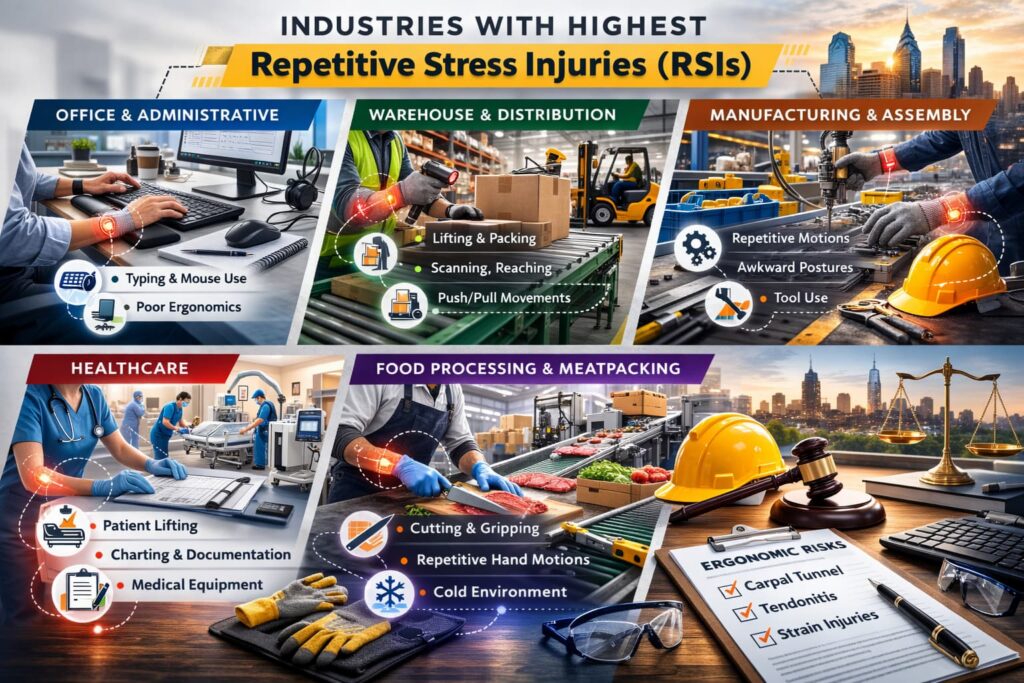
RSIs affect workers across industries, but certain occupations face dramatically higher risks due to their physical demands.
Office and Administrative Work
Decades of keyboard and mouse use take a toll. Office workers develop carpal tunnel syndrome, cubital tunnel syndrome, and tendonitis from the seemingly benign act of typing and clicking.
Poor workstation setup—monitors too high or low, keyboards at wrong angles, chairs without proper support—accelerates these injuries. The shift to remote work created new ergonomic challenges.
Workers using laptops on kitchen tables, couches, and makeshift home offices developed RSIs at increasing rates. When employers provided equipment for remote work, defects in that equipment can create third-party liability.
Warehouse and Distribution
Philadelphia's logistics sector employs thousands of workers performing repetitive lifting, scanning, packing, and material handling.
Warehouse workers develop:
- Carpal tunnel from constant box manipulation and scanner use
- Shoulder tendonitis from repetitive reaching
- Back injuries from lifting in constrained spaces
- Elbow injuries from pulling and pushing carts
The pressure to meet productivity quotas—often tracked by automated systems monitoring workers' movements—can push workers to maintain harmful paces without adequate rest.
Manufacturing and Assembly
Assembly line work defines repetitive stress. Workers perform the same motions thousands of times per shift—tightening fasteners, positioning components, operating controls, inspecting products. This repetition creates ideal conditions for RSIs.
Manufacturing equipment designed without ergonomic consideration forces workers into harmful postures and motions. When that equipment comes from third-party manufacturers, liability claims become possible.
Healthcare
Nurses, aides, and other healthcare workers face RSI risks from patient handling (lifting, repositioning, transferring), repetitive charting on computers, and sustained awkward postures during procedures.
Hospital workers develop back injuries, shoulder problems, and wrist conditions at rates exceeding most other industries. Medical equipment manufacturers who design patient handling devices, hospital beds, and other equipment without adequate attention to caregiver ergonomics may face liability when their products contribute to healthcare worker RSIs.
Food Processing and Meatpacking
Cutting, deboning, and processing food products requires rapid, repetitive hand and arm motions—often in cold environments that increase injury risk. Food processing workers develop carpal tunnel syndrome at rates far above the general working population.
The knives, processing equipment, and workstation designs used in these facilities often come from third-party suppliers. Defective or poorly designed equipment creates potential third-party claims.
FAQs
How long does carpal tunnel syndrome take to develop before I can file a claim?
There's no minimum duration. Carpal tunnel can develop over months or years depending on exposure intensity. You can file a workers' compensation claim once you have a diagnosis and medical evidence connecting the condition to your work duties.
For third-party lawsuits, Pennsylvania's two-year statute of limitations generally runs from when you knew or should have known your injury was caused by the defendant's conduct—which may be when a doctor first identifies the connection.
Can I file a claim if I had carpal tunnel symptoms before starting this job?
Yes, but it may be more complex. Pennsylvania recognizes aggravation claims where work duties worsen a pre-existing condition. If your job significantly aggravated previously minor or asymptomatic carpal tunnel into a disabling condition, you may still recover workers' compensation benefits and potentially pursue third-party claims. Medical evidence documenting the progression of your condition becomes especially important.
What if my employer provided ergonomic equipment, but I still got injured?
The equipment itself may be defective or inadequate despite being labeled ergonomic. If the keyboard, chair, or other equipment your employer provided caused your injury due to design flaws, the manufacturer—not your employer—may be liable.
Additionally, if an outside ergonomic consultant recommended that specific equipment, their negligent recommendation could create liability.
Do I need to prove my employer did something wrong to recover workers' compensation for an RSI?
No. Workers' compensation is a no-fault system—you receive benefits if your injury arose from employment, regardless of whether your employer was negligent. However, you do need medical evidence establishing that your work duties caused or contributed to your condition. The challenge with RSI claims isn't proving fault; it's proving the work connection against employer arguments that other factors caused your injury.
Can I sue a software company if their program's interface contributed to my RSI?
Potentially. Software designers who create interfaces requiring excessive clicking, awkward motions, or prolonged static postures may face design defect claims if those design choices cause RSIs.
This is an emerging area of liability as courts grapple with how product liability principles apply to software. The strength of such a claim depends on evidence that the software's design was unreasonably dangerous compared to feasible alternatives.
Contact a Philadelphia Workplace Injury Attorney

Repetitive stress injuries steal your ability to work without pain, pursue hobbies, and live the life you had before the damage accumulated.
If defective equipment, poorly designed tools, or negligent consultants contributed to your condition, you may have options beyond workers' compensation that can provide full compensation for everything you've lost.
Oakes Firm investigates ergonomic workplace injury claims throughout Philadelphia, identifying third-party defendants whose products or services caused harm. We work with medical professionals and ergonomic specialists to build compelling cases against equipment manufacturers and negligent consultants.
Attorney Thomas G. Oakes II has recovered countless millions for injured workers, and he brings aggressive advocacy and personal attention to every case.
Contact Oakes Firm today for a free consultation with an experienced Philadelphia personal injury lawyer.
We review your situation, explain whether third-party claims may be available, and answer your questions—with no obligation.