The delivery route you'd driven a thousand times. The client meeting across town. The supply run your boss asked you to make. Then someone ran a red light, and suddenly you're dealing with injuries, medical bills, and the confusing overlap of workers' compensation, auto insurance, and civil liability.
A workplace vehicle accident in Philadelphia triggers legal options that ordinary car crashes don't—but also raises questions most injured workers don't know to ask. Here's what makes these cases different: you may have claims against multiple parties under multiple legal theories, with multiple insurance policies potentially covering your losses.
The driver who hit you. Your employer's workers' comp carrier. The company that failed to maintain the vehicle you were driving. The leasing company that put a defective truck on the road. Each path to compensation has different rules, different damages available, and different deadlines.
Missing any of them means leaving money on the table.
Reach out to a Philadelphia workplace accident lawyer today to protect all available claims after a work-related vehicle crash and maximize your recovery.
Schedule A Free Case Consultation
The Legal Reality
- Workers injured in vehicle accidents while performing job duties generally qualify for workers' compensation benefits regardless of fault
- Third-party claims against the at-fault driver allow injured workers to recover damages beyond workers' compensation, including pain and suffering
- Fleet maintenance failures by employers, leasing companies, or maintenance contractors can create additional third-party liability
- Rideshare and delivery drivers face unique coverage questions depending on their employment classification and app status at the time of the crash
- Pennsylvania's commercial vehicle insurance requirements provide higher coverage limits than personal auto policies
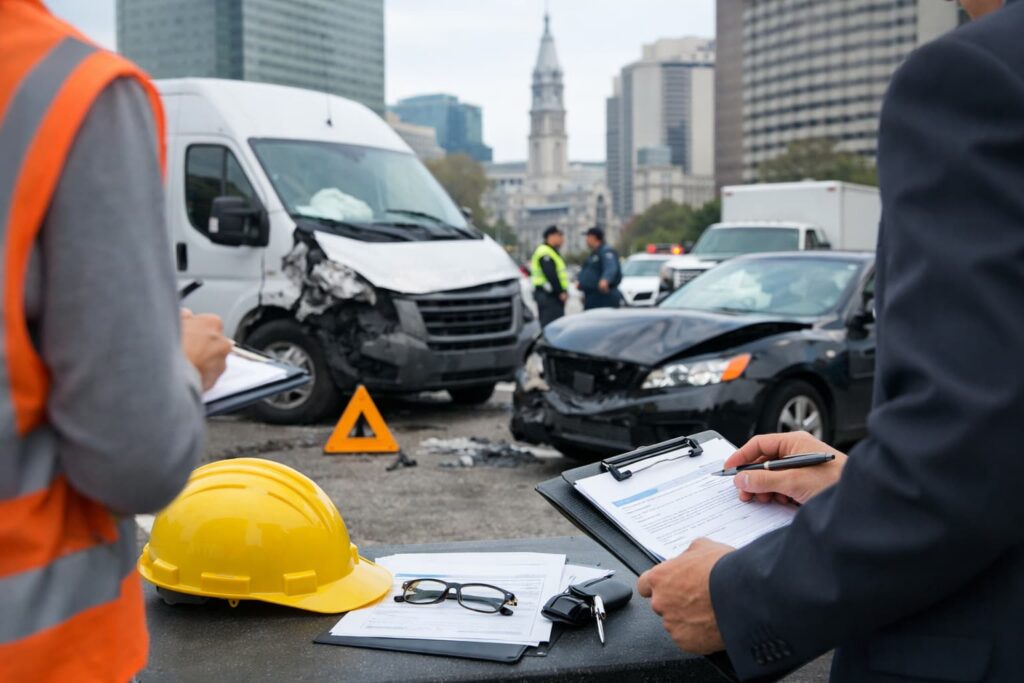
Does Workers' Compensation Cover Vehicle Accidents?
If you were injured in a car crash while performing work duties, workers' compensation generally covers your injuries—even if the accident was entirely your fault. Pennsylvania's Workers' Compensation Act provides no-fault benefits for injuries arising in the course of employment.
Driving for work falls squarely within that coverage. Delivery drivers, sales representatives, service technicians, truck drivers, and anyone else whose job requires vehicle travel can claim workers' comp benefits after a crash that occurs during work hours or while performing work duties.
Workers' comp benefits for vehicle accident injuries include:
- Medical treatment for all crash-related injuries
- Wage loss benefits (approximately two-thirds of your average weekly wage, subject to caps)
- Specific loss benefits for permanent impairments like amputations or loss of use
- Death benefits for surviving dependents if the crash proves fatal
But workers' comp has significant limitations. It doesn't cover pain and suffering. It caps wage replacement below your actual lost income. And it's typically your exclusive remedy against your employer—meaning you can't sue your employer for additional damages even if their negligence contributed to the crash.
That exclusivity rule is precisely why third-party claims matter so much in workplace vehicle accidents.
When Can You Sue the Other Driver?
Workers' compensation doesn't prevent you from suing third parties whose negligence caused your injuries. If another driver caused the crash that injured you while driving for work in Pennsylvania, you can pursue a personal injury claim against that driver—and recover damages that workers' comp doesn't provide.
What Third-Party Claims Offer
A civil lawsuit against the at-fault driver can recover:
- Full lost wages without workers' comp caps
- Pain and physical suffering
- Emotional distress
- Loss of enjoyment of life
- Loss of consortium (your spouse's separate claim)
- Future medical expenses and diminished earning capacity
These damages often dwarf what workers' compensation provides. A worker with serious injuries may receive $50,000 in workers' comp benefits but have a third-party claim worth several times that amount.
Pennsylvania's Auto Insurance Rules
Pennsylvania operates under a choice no-fault system for auto insurance. Drivers choose between limited tort and full tort coverage when purchasing policies. This choice affects what damages you can recover after a crash.
Limited tort restricts your ability to sue for pain and suffering unless you suffer a serious injury—defined as death, serious impairment of a body function, or permanent serious disfigurement. Full tort preserves your right to sue for all damages regardless of injury severity.
When you're injured while driving a work vehicle, multiple policies may apply—your personal auto policy, your employer's commercial policy, and the at-fault driver's policy.
Which policy's tort election controls depends on the specific circumstances. Commercial auto policies typically default to full tort coverage, which may benefit employees injured while driving company vehicles.
Uninsured and Underinsured Motorist Coverage
What happens when the driver who hit you has no insurance or insufficient coverage? Uninsured motorist (UM) and underinsured motorist (UIM) coverage fills the gap.
If the at-fault driver is uninsured, you can claim against your employer's UM coverage (or your personal policy if driving your own vehicle for work). If their coverage is insufficient to compensate your injuries, UIM coverage provides additional recovery up to policy limits.
Commercial auto policies often carry higher UM/UIM limits than personal policies. This additional coverage can prove invaluable when a work-related crash involves a defendant with minimal insurance.
Schedule A Free Case Consultation
Can You Sue for Defective or Poorly Maintained Vehicles?
Sometimes the crash wasn't caused by another driver—the vehicle itself failed. Brakes that didn't stop. Tires that blew out. Steering that locked up. When vehicle defects or maintenance failures cause workplace crashes, third-party claims against responsible parties become available.
Employer Fleet Maintenance Liability
Wait—didn't we just say you can't sue your employer? That's true for workers' compensation purposes, but employers aren't always protected when their negligent fleet maintenance causes injuries.
Pennsylvania courts have recognized exceptions to workers' comp exclusivity when employer conduct goes beyond ordinary negligence. And even within the workers' comp system, evidence of maintenance failures strengthens your claim and may increase benefits.
More importantly, employers often outsource fleet maintenance to third-party mechanics, shops, or service companies. These outside contractors have no workers' comp immunity.
If a maintenance contractor negligently serviced your work vehicle—missing worn brakes, failing to identify defective components, or performing repairs incorrectly—you can sue them directly.
Vehicle Leasing Company Liability
Many businesses lease their fleet vehicles rather than owning them outright. Leasing companies have contractual and sometimes legal obligations to maintain vehicles in safe condition.
When a leasing company's maintenance failures contribute to a crash, they face third-party liability. Commercial truck leases often specify which party is responsible for maintenance and inspections.
Violations of these obligations—or failures to ensure required maintenance actually occurs—can support negligence claims against leasing companies.
Vehicle and Parts Manufacturers
Product liability claims target manufacturers when design defects or manufacturing flaws cause vehicles to crash or fail to protect occupants. These claims don't require proving negligence—under Pennsylvania's strict liability rules, manufacturers are liable for defective products that cause injury.
Defective vehicle claims may involve:
- Brake system failures
- Tire defects causing blowouts
- Steering and suspension failures
- Accelerator malfunctions
- Defective seatbelts, airbags, or other safety equipment
- Roof crush in rollover accidents
- Fuel system defects causing post-crash fires
When a company vehicle crash in Philadelphia results from a product defect, the manufacturer—not your employer—may bear primary responsibility for your injuries.
What Happens When You're Partially at Fault?
Pennsylvania follows a modified comparative negligence rule. If you bear some responsibility for the crash, your recovery gets reduced by your percentage of fault—but you can still recover as long as you were less than 51% at fault.
For example, if a jury determines you suffered $200,000 in damages but were 20% at fault for the accident, your recovery would be reduced to $160,000. If you were 51% or more at fault, you recover nothing from the other driver.
Workers' compensation operates differently. Because workers' comp is no-fault, your own negligence doesn't reduce your benefits. Even if you caused the crash entirely, workers' comp covers your work-related injuries.
This distinction creates strategic considerations. If fault is contested or you may bear significant responsibility for the crash, workers' comp provides guaranteed benefits. A third-party claim offers higher potential recovery but carries the risk of reduced or barred recovery if fault findings go against you.
FAQs
What if I was running a personal errand when the crash happened?
Coverage depends on the specific circumstances. If you deviated substantially from work duties for personal reasons, your injuries might not qualify as arising in the course of employment for workers' comp purposes.
However, minor deviations—stopping for coffee during a delivery route, for example—typically don't defeat coverage. The key question is whether you'd substantially abandoned your work duties at the time of the crash.
Third-party claims against the at-fault driver remain available regardless of whether you were technically on the clock.
Can I receive both workers' compensation and damages from a lawsuit?
Yes, but there's a catch. You can pursue workers' comp benefits and a third-party lawsuit simultaneously. However, your workers' comp carrier has subrogation rights—meaning they may be entitled to reimbursement from your third-party recovery for benefits they've already paid. We structure settlements to minimize subrogation impacts and maximize your net recovery.
What if my employer doesn't have workers' compensation insurance?
Pennsylvania requires most employers to carry workers' comp insurance. Uninsured employers face criminal penalties and personal liability for workplace injuries.
If your employer illegally failed to maintain coverage, you can pursue compensation through the Uninsured Employers Guaranty Fund and may also sue your employer directly—since employers who fail to maintain required coverage lose their workers' comp immunity.
Do I need to report a work vehicle accident to my employer?
Yes. Report workplace injuries to your employer promptly. Pennsylvania workers' comp law requires notice within 120 days, but immediate reporting protects your rights and creates documentation.
Failure to report can jeopardize your benefits and create credibility issues later. Document the crash thoroughly—take photos, get witness contact information, obtain a police report, and preserve all evidence.
What if the crash was caused by a road defect rather than another driver?
Hazardous road conditions—potholes, debris, inadequate signage, missing guardrails—may create liability for the entity responsible for road maintenance.
Claims against municipal or state government entities face special rules under Pennsylvania's Political Subdivision Tort Claims Act, including short notice deadlines and damage caps. We investigate road conditions in every vehicle accident case to identify all potentially liable parties.
Contact a Philadelphia Workplace Vehicle Accident Attorney

A crash that happens while you're working opens legal options that most injured workers never learn about.
Workers' comp covers your immediate needs, but third-party claims against negligent drivers, vehicle manufacturers, maintenance companies, and others can recover full compensation for everything you've lost—pain and suffering, complete wage replacement, and damages for how the crash has changed your life.
Oakes Firm handles workplace vehicle accident cases throughout Philadelphia, investigating every potential source of recovery and fighting aggressively against insurance companies and negligent parties.
We coordinate workers' comp claims with third-party litigation to maximize your total compensation. Attorney Thomas G. Oakes II has recovered countless millions for injured workers and brings relentless advocacy to every case.
Contact Oakes Firm today for a free consultation with a dedicated personal injury lawyer in Philadelphia. We review your accident, identify all available claims, and answer your questions—with no obligation.