When a worker dies on the job in Pennsylvania, their family may have legal options beyond workers' compensation death benefits.
Workplace wrongful death claims in Philadelphia allow surviving family members to pursue compensation from third parties whose negligence contributed to the fatal accident—equipment manufacturers, property owners, general contractors, or subcontractors who weren't the deceased's direct employer.
Workers' compensation provides limited, no-fault benefits to families after a workplace death. But those benefits often fall far short of what families actually lose. Third-party wrongful death claims can recover damages that workers' comp doesn't cover: pain and suffering, full lost wages without statutory caps, and loss of companionship.
For families who lost a breadwinner to a preventable construction accident death in Pennsylvania or other workplace fatality, identifying liable third parties may significantly increase available compensation.
Reach out to a Philadelphia wrongful death lawyer today to evaluate third-party liability and take decisive action to secure the full compensation your family deserves after a workplace death.
Schedule A Free Case Consultation
What the Law Says
- Workers' compensation death benefits in Pennsylvania are limited and don't require proving fault
- Third-party wrongful death claims allow families to sue parties other than the employer for negligence
- OSHA violations can serve as evidence of negligence, but don't automatically create civil liability
- Common third-party defendants include equipment manufacturers, property owners, general contractors, and subcontractors
- Pursuing both workers' compensation and third-party claims may maximize the total recovery available to the family
How Do Workers' Compensation Death Benefits Work in Pennsylvania?
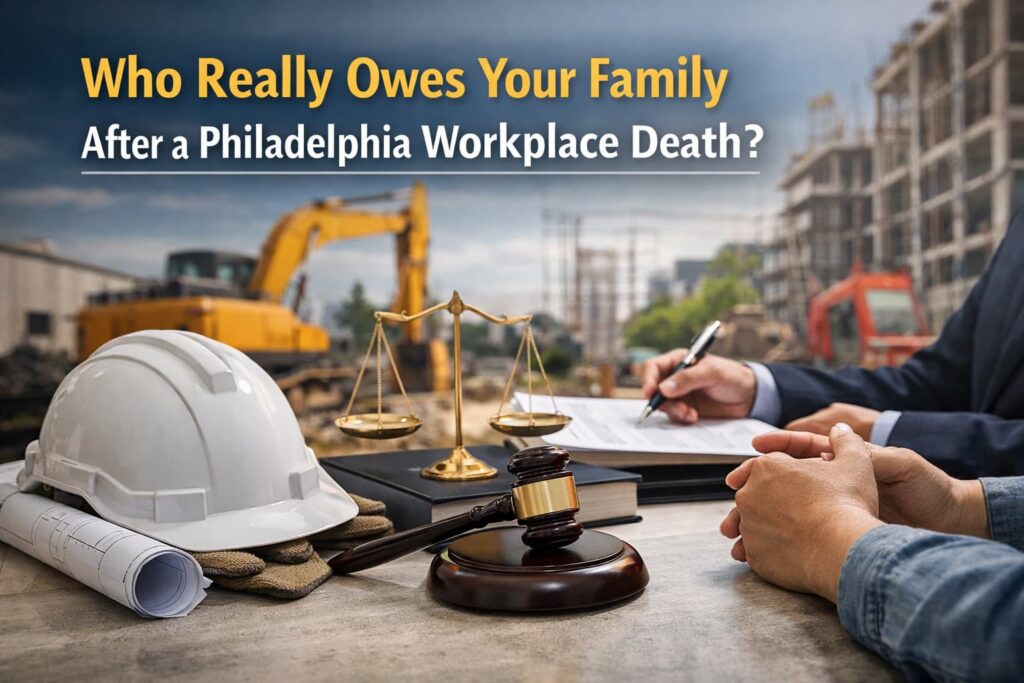
Pennsylvania's Workers' Compensation Act provides death benefits to eligible dependents when a worker dies from a work-related injury or illness. These benefits are no-fault—the family doesn't need to prove the employer did anything wrong. If the death arose from employment, benefits flow automatically.
Death benefits under Pennsylvania workers' compensation include:
- Weekly wage-loss payments to eligible dependents (spouse, children, dependent parents)
- Payment of reasonable funeral expenses up to $7,000
- Medical expenses incurred between the injury and death
The weekly benefit amount equals a percentage of the deceased worker's average weekly wage, subject to statutory maximums. A surviving spouse with no dependent children receives benefits for life or until remarriage.
Dependent children receive benefits until age 18 (or 23 if enrolled in school full-time). These benefits provide crucial financial support, but they have significant limitations.
Workers' comp doesn't compensate families for loss of companionship, emotional suffering, or the full value of the deceased's future earning potential. Families cannot sue the employer directly in most cases—workers' compensation is typically the exclusive remedy against an employer for workplace injuries and deaths.
That exclusivity rule is exactly why third-party liability claims matter.
What Is Third-Party Liability in a Workplace Death?
Third-party liability workplace death claims target parties other than the employer whose negligence contributed to the fatal accident. Because these defendants aren't protected by workers' compensation exclusivity, families can pursue full civil damages against them—including compensation for losses that workers' comp doesn't cover.
Identifying third-party defendants requires investigating everyone who had a role in creating the dangerous conditions that caused the death. On construction sites, industrial facilities, and other high-risk workplaces, multiple parties share responsibility for safety.
Equipment and Machinery Manufacturers
Defective equipment causes thousands of workplace fatalities nationally each year. When a worker dies because machinery malfunctioned, lacked proper safety guards, or included inadequate warnings, the manufacturer may face strict product liability claims.
Under Pennsylvania law, manufacturers can be held strictly liable for defective products that cause injury—meaning families may recover damages by showing the product was defective, and that defect caused the death, even without evidence of carelessness in the manufacturing process.
Property Owners
Property owners have a duty to maintain reasonably safe conditions for workers on their premises. When hazardous conditions on the property contribute to a fatal workplace accident, the property owner may share liability—even if they didn't directly employ the deceased worker.
A construction worker who falls through a rotted floor, an electrician electrocuted by faulty building wiring, or a delivery driver killed by a collapsing structure may all have third-party claims against the property owner.
The key question is whether the property owner knew or should have known about the dangerous condition and failed to address it or warn workers.
General Contractors and Subcontractors
Construction sites involve layers of contractors and subcontractors, each responsible for different aspects of the project. When one contractor's negligence causes a worker employed by a different contractor to die, a third-party claim may be available.
Pennsylvania courts recognize that general contractors often retain significant control over job site safety. That control can translate to legal responsibility when failures contribute to fatal accidents.
Architects and Engineers
Design professionals may face liability when their defective plans or specifications create dangerous conditions that lead to worker deaths. A structural engineer whose calculations prove faulty, an architect who specifies inadequate fall protection systems, or a designer who creates plans requiring workers to operate in unnecessarily hazardous positions may all share responsibility for resulting fatalities.
These claims require demonstrating that the design deviated from professional standards and that the design defect—not just construction execution—contributed to the death.
What Role Do OSHA Violations Play in Wrongful Death Claims?
The Occupational Safety and Health Administration (OSHA) sets federal workplace safety standards that employers must follow. When employers violate these standards, and a worker dies, the OSHA violation becomes powerful evidence in a wrongful death claim—but it doesn't automatically establish civil liability.
OSHA Violations as Evidence of Negligence
Pennsylvania courts allow evidence of OSHA violations to help prove that a defendant failed to meet reasonable safety standards. If OSHA requires fall protection at heights above six feet on construction sites, and a contractor failed to provide that protection before a fatal fall, the violation strongly supports a negligence claim.
Evidence of OSHA violations can establish:
- What safety measures were required under federal standards
- That the defendant knew or should have known about these requirements
- That the defendant failed to implement required protections
- That this failure contributed to the fatal accident
OSHA citations issued after a workplace fatality investigation are particularly valuable. They represent a federal agency's formal determination that safety violations occurred.
OSHA Investigations and Citations
OSHA investigates workplace fatalities, typically conducting on-site inspections within days of a fatal accident. These investigations generate detailed reports documenting safety violations, witness statements, photographs, and the agency's conclusions about what went wrong.
OSHA can issue citations and substantial fines for violations that contributed to worker deaths. Willful violations—where the employer intentionally disregarded safety requirements—carry the highest penalties.
While OSHA enforcement is separate from civil wrongful death litigation, the evidence generated through OSHA investigations often proves invaluable in building third-party liability claims. We obtain OSHA investigation files, citation records, and related documentation to support wrongful death cases.
OSHA Violations Don't Guarantee Civil Recovery
An OSHA violation doesn't automatically mean a wrongful death lawsuit will succeed. Families must still prove that the violation caused the death and that the defendant owed a duty to the deceased worker.
A defendant might argue that the violation was unrelated to the fatal accident, or that the worker's own actions were the actual cause. Additionally, OSHA doesn't regulate every aspect of workplace safety.
Some dangerous conditions may not violate any specific OSHA standard but still constitute negligence under general duty principles.
Schedule A Free Case Consultation
What Are Common Construction Site Accidents That Cause Death?
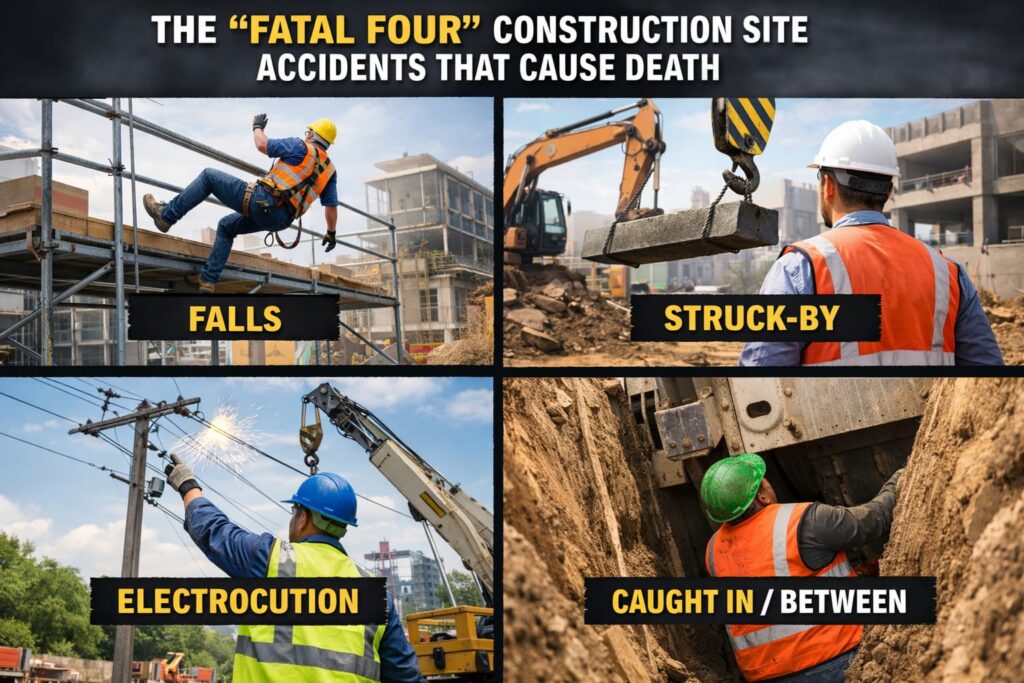
Construction consistently ranks among the most dangerous industries in America. OSHA identifies four categories of hazards—the Fatal Four—that account for the majority of construction worker deaths nationwide.
Falls
Falls from elevation remain the leading cause of construction accident death in Pennsylvania and across the country. Workers fall from scaffolding, ladders, roofs, structural steel, and aerial lifts. Inadequate fall protection, improperly secured scaffolding, and failure to guard floor openings contribute to these fatalities.
OSHA's fall protection standards require guardrails, safety nets, or personal fall arrest systems for workers at heights above six feet on construction sites. Violations of these requirements frequently appear in fatal fall investigations.
Struck-By Accidents
Workers die when struck by falling objects, swinging loads, vehicles, or equipment on construction sites. Crane loads that drop or swing unexpectedly, materials falling from upper floors, and vehicles backing over workers in congested areas all fall into this category.
Proper barricades, warning systems, protective equipment, and communication protocols can prevent many struck-by fatalities. When contractors fail to implement these measures, third-party liability claims may follow.
Electrocution
Contact with power lines, faulty wiring, and energized equipment causes fatal electrocutions on construction sites. Workers may encounter live electrical systems during renovation work, accidentally strike buried power lines during excavation, or contact overhead lines with cranes or other equipment.
Electrical fatalities often involve multiple liable parties—the contractor who failed to de-energize systems, the property owner who didn't disclose electrical hazards, or the utility company that failed to properly mark buried lines.
Caught-In/Between Accidents
Workers die when caught in or compressed by equipment, materials, or collapsing structures. Trench collapses bury workers in seconds. Unguarded machinery pulls workers into moving parts.
Collapsing walls or structures crush workers below.
OSHA's excavation and trenching standards require protective systems—shoring, sloping, or trench boxes—for excavations five feet or deeper. Violations of these standards frequently contribute to caught-in fatalities.
FAQs
Can families sue the employer directly for a workplace death?
In most cases, no. Pennsylvania's Workers' Compensation Act provides the exclusive remedy against employers for work-related injuries and deaths.
Families receive workers' comp death benefits but cannot sue the employer in civil court. The exception is rare cases involving intentional employer conduct that goes beyond ordinary negligence—but this threshold is extremely difficult to meet.
What if the deceased worker was partially at fault for the accident?
Pennsylvania's comparative negligence rules apply to third-party wrongful death claims. If the deceased worker bore some responsibility for the accident, the recovery gets reduced by their percentage of fault. However, as long as the worker was less than 51% responsible, the family can still recover from other liable parties.
How long do families have to file a workplace wrongful death claim?
Pennsylvania's statute of limitations for wrongful death claims is two years from the date of death.
Workers' compensation death benefits have separate filing deadlines—dependents generally must notify the employer within 120 days and file a claim petition within three years. Starting early protects all available options.
What evidence helps prove third-party liability in a workplace death?
Key evidence includes OSHA investigation reports and citations, accident scene photographs, equipment maintenance records, contracts showing which parties controlled job site safety, witness statements, safety meeting logs, and any communications about known hazards. We investigate thoroughly to gather evidence before it disappears or gets altered.
Can families recover if the workplace was unionized?
Union status doesn't prevent third-party wrongful death claims. Collective bargaining agreements may affect workers' compensation procedures, but they don't shield negligent third parties—equipment manufacturers, property owners, or other contractors—from civil liability. Union workers' families have the same third-party claim rights as non-union workers' families.
Contact a Philadelphia Workplace Wrongful Death Attorney

Losing a family member to a preventable workplace accident is devastating—especially when you learn that safety violations or third-party negligence contributed to the death.
Workers' compensation death benefits alone rarely reflect the true value of what your family lost. Oakes Firm investigates workplace wrongful death cases throughout Philadelphia, identifying all liable third parties and building aggressive claims for maximum compensation.
We obtain OSHA records, work with safety professionals to document violations, and fight hard against equipment manufacturers, property owners, and negligent contractors.
Attorney Thomas G. Oakes II has recovered countless millions for families harmed by negligence, and he treats every client with the personal attention and compassion they deserve.
Contact Oakes Firm today for a free consultation. We review your case, explain your options for recovery beyond workers' compensation, and answer your questions—with no obligation.