In Pennsylvania, only the personal representative of the deceased person's estate can file a wrongful death lawsuit—not individual family members acting on their own.
This personal representative brings the claim on behalf of specific beneficiaries defined by state law, typically the surviving spouse, children, or parents of the person who died.
Pennsylvania's wrongful death laws are strict about standing—the legal right to bring a lawsuit. Filing incorrectly or without proper authority can delay your case or result in dismissal.
Reach out to a trusted Philadelphia wrongful death lawyer at Oakes Firm today to protect your family’s rights and ensure your claim is filed properly.
Schedule A Free Case Consultation
Legal Points
- Only the personal representative of the deceased's estate has standing to file a wrongful death lawsuit in Pennsylvania
- Wrongful death beneficiaries in Pennsylvania include the surviving spouse, children, and parents of the deceased
- A survival action is a separate claim that compensates the estate for the deceased's losses before death
- Pennsylvania courts appoint a personal representative if no will exists or the named executor cannot serve
- Siblings, grandparents, and other extended family members generally cannot recover wrongful death damages unless they were financially dependent on the deceased

What Is a Personal Representative in a Wrongful Death Claim?
The personal representative is the person legally authorized to manage a deceased person's estate and act on its behalf in legal matters. In a wrongful death claim, this individual files the lawsuit and makes decisions throughout the litigation process—but any compensation recovered goes to the eligible beneficiaries, not to the representative personally (unless they're also a beneficiary).
Pennsylvania's Wrongful Death Act (42 Pa. C.S. § 8301) specifically grants this filing authority to the personal representative. The representative may be:
- The executor named in the deceased person's will
- An administrator appointed by the court if there's no will
- A family member who petitions the court for appointment
The personal representative has a fiduciary duty to act in the best interests of the beneficiaries. This means pursuing the claim diligently, making reasonable litigation decisions, and distributing any recovery according to Pennsylvania law.
Who Are Wrongful Death Beneficiaries in Pennsylvania?
While the personal representative files the lawsuit, the compensation flows to the wrongful death beneficiaries defined by statute. Pennsylvania law establishes a specific hierarchy of who can receive damages.
Spouse, Children, and Parents
The primary wrongful death beneficiaries in Pennsylvania are:
- The surviving spouse of the deceased
- The surviving children of the deceased, including legally adopted children
- The surviving parents of the deceased, if there is no spouse or children
These individuals can recover damages for their losses resulting from the death, including loss of companionship, loss of expected income the deceased would have provided, funeral expenses, and loss of guidance or parental care.
When multiple beneficiaries exist, such as a surviving spouse and three children, the personal representative brings a single lawsuit on behalf of all of them. Any settlement or verdict is then distributed among the beneficiaries according to Pennsylvania intestate succession laws or a court determination.
What About Other Family Members?
Siblings, grandparents, aunts, uncles, and other extended relatives generally do not qualify as wrongful death beneficiaries under Pennsylvania law. This surprises many families who assumed a close relationship would grant legal standing.
However, there is a limited exception. If no spouse, children, or parents survive the deceased, other relatives who were financially dependent on the deceased may qualify to receive wrongful death damages.
Proving financial dependence typically requires documentation showing the deceased regularly provided monetary support that the relative relied upon for living expenses.
This is a narrow exception. Emotional closeness alone, no matter how significant, does not establish legal standing to recover wrongful death damages in Pennsylvania.
How Does Someone Become a Personal Representative?
The path to becoming a personal representative depends on whether the deceased left a valid will.
When There Is a Will
If the deceased had a will, it likely names an executor. This person must petition the Register of Wills in the county where the deceased lived to be officially appointed.
Once the court issues Letters Testamentary, the executor has legal authority to act as personal representative—including filing a wrongful death lawsuit.
Sometimes the named executor cannot serve or decline the role. This happens when the executor:
- Has passed away
- Is incapacitated
- Lives out of state and cannot fulfill the duties
- Has a conflict of interest
- Simply doesn't want the responsibility
In these situations, the court appoints an alternate, often a family member who petitions for the role.
When There Is No Will
When someone dies without a will (intestate), the court appoints an administrator to manage the estate. Pennsylvania law establishes a priority order for who may petition to serve as administrator:
- Surviving spouse
- Children
- Parents
- Siblings
- Other next of kin
The person with highest priority who petitions the court typically receives appointment. Once the court issues Letters of Administration, the administrator has the same authority as an executor to file a personal representative wrongful death claim.
This process takes time. Families grieving a sudden loss must simultaneously deal with probate court paperwork—another reason consulting with a wrongful death attorney early makes a significant difference.
Schedule A Free Case Consultation
What Is the Difference Between a Wrongful Death Claim and a Survival Action?
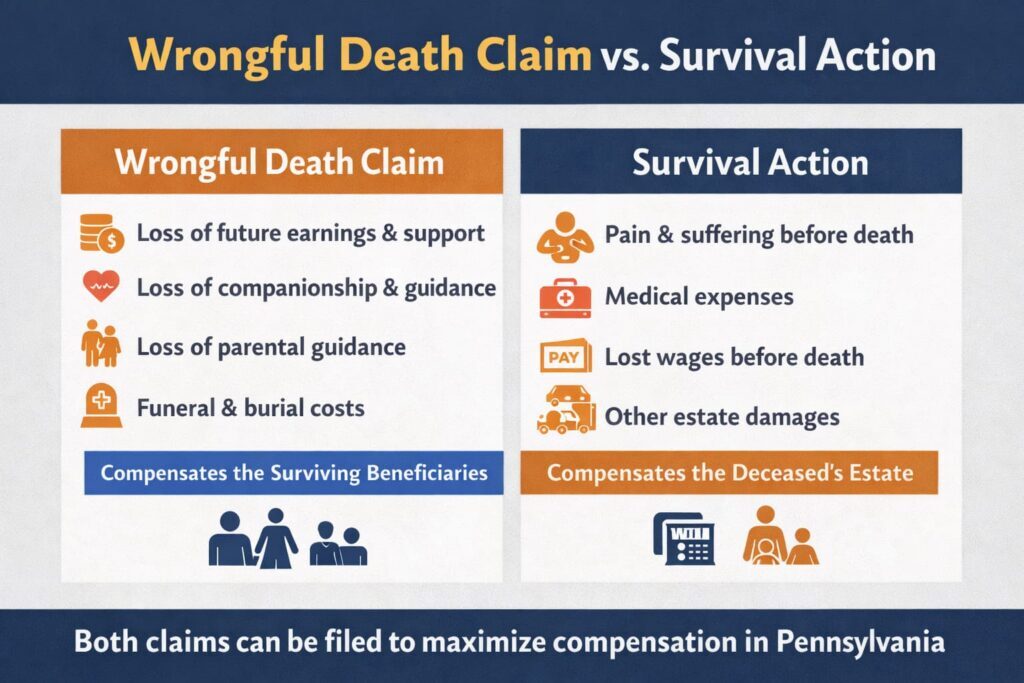
Pennsylvania law allows two separate but related claims after a fatal injury. Families often confuse them, but they compensate for different losses and benefit different parties.
Wrongful Death Claim
A wrongful death claim compensates the surviving beneficiaries for their losses caused by the death. This includes:
- Loss of the deceased's expected future earnings and financial support
- Loss of companionship, comfort, and society
- Loss of parental guidance for minor children
- Funeral and burial expenses
The personal representative files this claim on behalf of the statutory beneficiaries (spouse, children, parents). The recovery belongs to the beneficiaries, not the estate.
Survival Action
A survival action, authorized under 42 Pa. C.S. § 8302, compensates the deceased's estate for losses the deceased suffered between the injury and death.
This includes:
- Pain and suffering the deceased experienced before dying
- Medical expenses incurred between injury and death
- Lost wages during that period
- Any other damages the deceased could have recovered if they had survived
The personal representative also files the survival action, but the recovery becomes part of the estate. It passes according to the will or intestate succession laws—which may include different people than the wrongful death beneficiaries.
Filing both claims together often maximizes the total compensation available to the family. An experienced wrongful death attorney evaluates both avenues in every case.
What Happens If There Are No Eligible Beneficiaries?
This situation is rare but does occur. When someone dies with no surviving spouse, children, or parents, the question becomes whether a wrongful death claim can proceed at all.
Pennsylvania allows other relatives who were financially dependent on the deceased to step into the beneficiary role. However, if no one can prove financial dependence, there may be no eligible wrongful death beneficiaries under the statute.
In these cases, a survival action may still be possible. The estate can pursue compensation for the deceased's pre-death pain and suffering, medical bills, and lost wages.
Any recovery would pass to heirs according to the will or intestate succession—potentially including siblings, nieces, nephews, or other relatives who wouldn't qualify for wrongful death damages.
The distinction matters significantly. Families who believe they have no legal recourse may actually have options through a survival action. An attorney can review the specific circumstances and identify all potential claims.
Common Misconceptions About Who Can File
Misunderstandings about wrongful death standing cause real problems for grieving families. Here are the most frequent misconceptions:
Any Family Member Can File a Lawsuit
Only the personal representative has standing to file. A sibling, adult child, or parent cannot independently file a wrongful death lawsuit—even if they're a beneficiary. The proper personal representative must be appointed and bring the claim on everyone's behalf.
I Don't Need to Open an Estate
You do. Without going through probate and obtaining Letters Testamentary or Letters of Administration, no one has legal authority to file the wrongful death lawsuit. Skipping this step means the lawsuit gets dismiss.
The Beneficiaries Decide How to Handle the Case
The personal representative makes litigation decisions, though they have a fiduciary duty to act in beneficiaries' best interests. Disagreements between the representative and beneficiaries can complicate cases—another reason choosing the right representative matters.
Living Together Is the Same as Being Married
Pennsylvania does not recognize common-law marriage for relationships established after January 1, 2005. An unmarried partner—regardless of how long the relationship lasted or whether they lived together—is not a statutory wrongful death beneficiary. This is a painful reality for many families.
Stepchildren Automatically Qualify
Stepchildren generally do not qualify as wrongful death beneficiaries unless they were legally adopted by the deceased. The biological or legal parent-child relationship determines standing under Pennsylvania law.
How Long Do You Have to File?
Pennsylvania imposes a two-year statute of limitations on wrongful death claims. This deadline runs from the date of death, not the date of the injury that caused the death.
Two years seems like ample time, but the process involves multiple steps:
- Obtaining appointment as personal representative through probate court
- Investigating the circumstances of death
- Identifying all liable parties
- Gathering evidence, medical records, and witness statements
- Filing the lawsuit with proper documentation
Starting the process early gives your attorney time to build the strongest possible case. Waiting until the deadline approaches creates unnecessary risk.
FAQs
Can a wrongful death lawsuit be filed if the death was caused by medical malpractice?
Yes. Medical malpractice is one of the most common grounds for wrongful death claims in Pennsylvania. The same rules about personal representatives and beneficiaries apply. However, medical malpractice cases also require a certificate of merit from a qualified medical professional before filing, which adds a procedural step that makes early consultation with an attorney important.
What if the personal representative and beneficiaries disagree about settling the case?
The personal representative has decision-making authority but owes fiduciary duties to the beneficiaries. If a representative acts against the beneficiaries' interests—such as accepting an unreasonably low settlement—beneficiaries may petition the court to remove and replace them. Courts can also require approval of settlements to protect beneficiaries' interests.
Can someone who was financially supported by the deceased file a wrongful death claim?
Potentially. If no spouse, children, or parents survive, financially dependent relatives may qualify as beneficiaries. However, they still cannot file the lawsuit themselves—a personal representative must be appointed to bring the claim on their behalf. Proving financial dependence typically requires documentation of regular monetary support.
Does Pennsylvania recognize wrongful death claims for unborn children?
Pennsylvania law allows wrongful death claims for the death of an unborn child if the child was viable at the time of the fatal injury. Viability generally means the fetus could have survived outside the womb. These cases involve complex legal and medical questions that require careful evaluation.
What happens to the wrongful death recovery if a beneficiary dies during the lawsuit?
If a beneficiary dies while the wrongful death case is pending, their share of any eventual recovery typically passes to their own estate. This can complicate distribution and may require additional probate proceedings. The lawsuit itself continues with the surviving beneficiaries.
How Do Wrongful Death Laws Differ Across Pennsylvania?
In Pennsylvania, wrongful death statutes apply equally across the state, yet they differ from another legal claim known as a Survival Action. Even though the two can be triggered by the same incident, each one fulfills a unique function and helps a specific group of people.
Key differences include:
- Wrongful Death Action: The claim is made for the benefit of the surviving family members (including husband/wife, kids, or parents). This is compensation to the family for their losses. These losses include the expense of funerals, lack of financial support, and loss of companionship and advice. These payments are made to the family and are tax-free.
- Survival Action: This is an asset belonging to the decedent's estate. The claim is said to be a claim that essentially "continues" the personal injury claim that the victim could have brought suit for if he or she were still alive. This includes damages such as those experienced by the victim for his funds going into the estate, they may be used to pay off debts or be subject to inheritance taxes.
- Who Can Benefit: Only a spouse, child, or parent can recover under a Wrongful Death claim. If the deceased had none of these relatives, the estate can only recover medical and funeral costs. However, siblings or other heirs can potentially benefit from a Survival Action if they are named in the deceased’s will.
- The Filing Timeline: Both actions are subject to a strict two year statute of limitations from the date of death.
Talk to a Philadelphia Wrongful Death Attorney

Figuring out who can file a wrongful death lawsuit in Pennsylvania adds stress to an already devastating situation. The legal requirements around personal representatives, beneficiaries, and standing are strict—and mistakes can cost your family valuable time or even bar recovery entirely.
Oakes Firm handles wrongful death claims for families throughout Philadelphia. We guide families through the probate process, investigate the circumstances of death, identify all liable parties, and fight aggressively to pursue the compensation your family may be entitled to recover.
Attorney Thomas G. Oakes II has secured countless millions of dollars for grieving families and treats every client with the compassion and personal attention they deserve during this difficult time.
Contact Oakes Firm today for a free consultation with a dedicated Philadelphia personal injury attorney. We review your case, explain your legal options, and answer your questions—with no obligation.