Federal safety regulations exist for one reason—to keep workers alive and uninjured. When employers and contractors ignore these rules, workers pay the price with crushed limbs, traumatic brain injuries, spinal cord damage, and burns that alter their lives forever.
OSHA violations in Philadelphia workplace accidents serve as powerful evidence that someone prioritized profits or convenience over human safety, and that evidence can strengthen your injury claim against negligent third parties.
The Occupational Safety and Health Administration investigates workplace injuries and issues citations when employers violate federal safety standards. But an OSHA citation and a personal injury lawsuit are two different things with different purposes.
OSHA penalizes employers with fines. A civil lawsuit compensates you for your actual losses—medical bills, lost wages, pain and suffering, and the lasting impact of a disabling injury.
Reach out to a Philadelphia workplace accident lawyer today to protect your rights and pursue full compensation beyond OSHA penalties for the injuries and losses you’ve suffered.
Schedule A Free Case Consultation
Legal Takeaways
- OSHA violations documented after a workplace accident provide evidence of negligence in third-party injury claims
- The most frequently cited OSHA violations in Philadelphia involve fall protection, hazard communication, scaffolding, and machine guarding
- Pennsylvania OSHA regulations mirror federal standards but are enforced by the state in certain industries
- OSHA citations punish employers with fines while personal injury lawsuits compensate injured workers for their losses
- Third-party claims allow injured workers to pursue damages beyond workers' compensation when someone other than the employer caused the injury
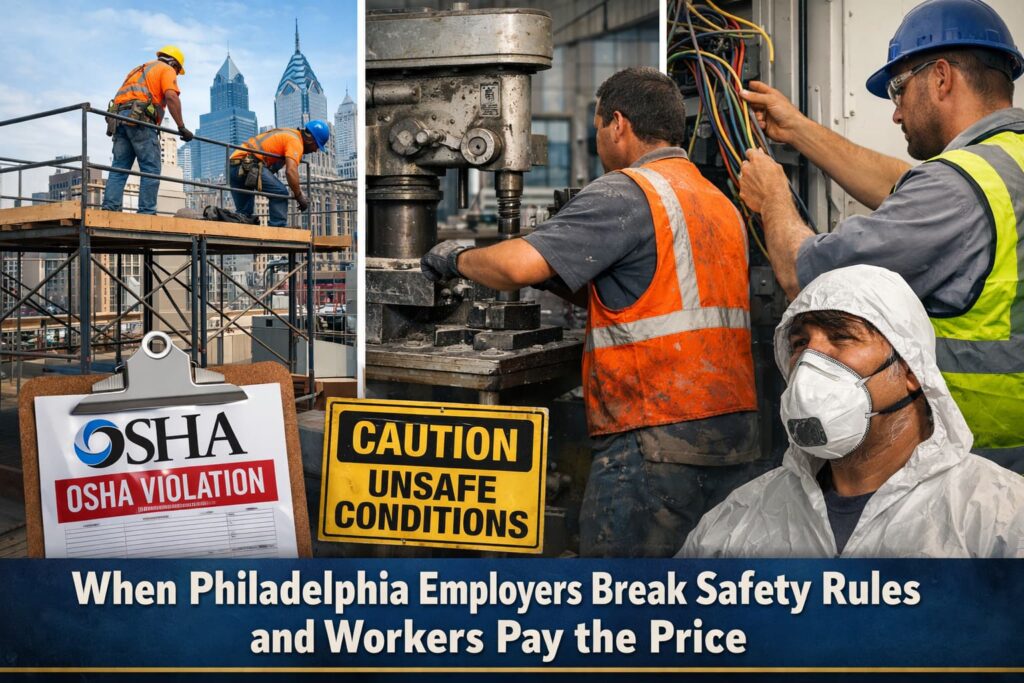
What Are the Most Common OSHA Violations That Injure Philadelphia Workers?
OSHA publishes its most frequently cited violations every year. The same hazards appear repeatedly because the same shortcuts keep injuring workers. Philadelphia's construction sites, warehouses, manufacturing facilities, and healthcare settings see these violations regularly.
Fall Protection Failures
Fall protection tops OSHA's most-cited list year after year. The standard is straightforward: workers at heights of six feet or more on construction sites need guardrails, safety nets, or personal fall arrest systems.
Yet contractors continue sending workers onto roofs, scaffolds, and elevated platforms without adequate protection. Fall protection violations cause some of the most catastrophic injuries—traumatic brain damage from hitting concrete, spinal fractures that result in paralysis, and multiple broken bones that require months of surgical repair.
Philadelphia's construction boom means more workers at elevation, and more opportunities for contractors to cut corners.
Common fall protection violations include:
- No guardrails on elevated platforms or floor openings
- Improperly anchored personal fall arrest systems
- Damaged or uninspected harnesses and lanyards
- Inadequate training on fall protection equipment use
- Failure to cover or guard holes in walking surfaces
When a contractor's fall protection failure causes your injury, that OSHA violation becomes central evidence in your third-party claim.
Machine Guarding Deficiencies
Manufacturing and industrial facilities rely on machinery that can amputate fingers, crush hands, or pull workers into moving parts in seconds. OSHA's machine guarding standards require guards on points of operation, ingoing nip points, rotating parts, and flying chips or sparks.
Philadelphia's manufacturing sector—food processing, metalworking, printing, and packaging operations—sees machine guarding violations regularly. Workers lose fingers to unguarded presses, suffer degloving injuries from exposed rollers, and sustain crush injuries when safety interlocks fail or don't exist.
Machine guarding violations often indicate multiple liable parties: the employer who removed or failed to maintain guards, and potentially the equipment manufacturer if the machine shipped without adequate safety features.
Hazard Communication Failures
Workers have a right to know what chemicals they're exposed to and how to protect themselves. OSHA's Hazard Communication Standard requires employers to maintain Safety Data Sheets, properly label chemical containers, and train workers on chemical hazards in their workplace.
When hazard communication fails, workers suffer chemical burns, respiratory damage, poisoning, and long-term occupational illnesses. Philadelphia healthcare workers face particular risks from disinfectants, sterilization chemicals, and hazardous drugs.
Manufacturing and warehouse workers encounter industrial solvents, cleaning agents, and materials they may not realize are dangerous. Violations include missing or outdated Safety Data Sheets, unlabeled chemical containers, no training on workplace chemical hazards, and failure to inform workers about hazardous substances they'll encounter.
Scaffolding Violations
Scaffolding collapses and falls from improperly constructed scaffolds injure hundreds of construction workers every year. OSHA's scaffolding standards specify load capacities, platform construction, guardrail requirements, and inspection protocols that contractors frequently ignore.
Philadelphia's commercial construction and renovation projects rely heavily on scaffolding. When contractors overload platforms, fail to install guardrails, use damaged components, or skip required inspections, workers fall or get crushed by collapsing structures.
Electrical Safety Violations
Contact with energized electrical systems causes electrocution, severe burns, and cardiac arrest. OSHA's electrical safety standards require lockout/tagout procedures when servicing equipment, proper grounding, and maintaining safe distances from power lines.
Philadelphia construction workers face electrical hazards during renovation of older buildings with outdated wiring, and from overhead power lines on job sites. Manufacturing and warehouse workers encounter electrical risks from machinery and facility systems.
Violations include failure to de-energize equipment before maintenance, missing or bypassed lockout/tagout procedures, improper grounding, and allowing equipment to operate within unsafe proximity to power lines.
Respiratory Protection Failures
Workers in construction, manufacturing, healthcare, and other industries face airborne hazards—silica dust, asbestos fibers, chemical vapors, and infectious agents. OSHA's respiratory protection standard requires employers to provide appropriate respirators, conduct fit testing, and implement respiratory protection programs.
When employers fail to assess airborne hazards, provide wrong or inadequate respirators, or skip mandatory fit testing, workers develop occupational lung diseases, chemical injuries to airways, and infections that proper protection would have prevented.
How Do OSHA Violations Strengthen Third-Party Injury Claims?
An OSHA violation doesn't automatically mean you'll win a personal injury lawsuit. But it provides compelling evidence that a defendant failed to meet baseline safety standards—evidence that's difficult for defense attorneys to explain away.
Violations Establish the Standard of Care
In negligence cases, the injured worker must prove the defendant failed to meet a reasonable standard of care. OSHA regulations define what safety measures federal law considers necessary.
When a defendant violated those regulations, it strongly suggests they fell below the standard a reasonable company would meet. Your attorney can present the specific OSHA standard, show the defendant violated it, and argue that compliance would have prevented your injury.
Jurors understand this logic: the rules existed, the defendant broke them, and you got hurt as a result.
Citations Document What Went Wrong
OSHA investigates serious workplace accidents and documents its findings. When OSHA issues citations, those citations describe exactly what the employer or contractor did wrong—which equipment lacked guards, which fall protection was missing, which safety procedures weren't followed.
This documentation becomes evidence in your civil case. Instead of relying solely on your memory of the accident scene, you have a federal agency's formal determination of what safety failures existed.
Willful Violations Indicate Egregious Conduct
OSHA classifies violations by severity. Willful violations—where the employer knowingly disregarded safety requirements—carry the highest penalties and indicate the most culpable conduct.
Evidence that a defendant willfully violated OSHA standards can support arguments for increased damages in your civil case. It demonstrates not just carelessness but conscious disregard for worker safety.
Schedule A Free Case Consultation
What's the Difference Between an OSHA Citation and a Personal Injury Lawsuit?
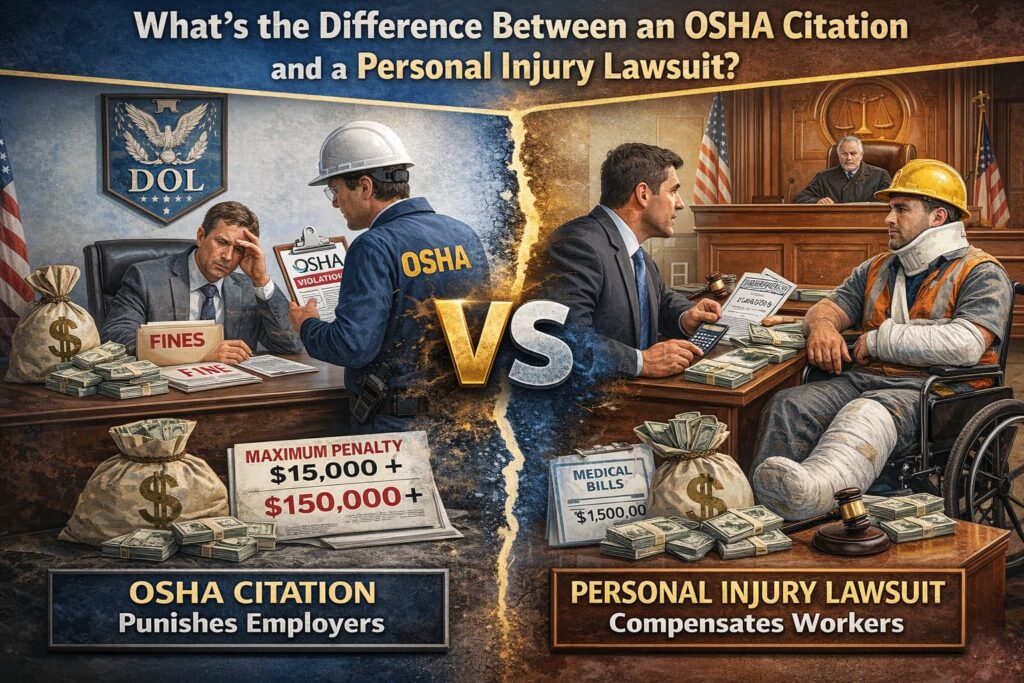
OSHA enforcement and civil litigation serve different purposes, follow different procedures, and deliver different outcomes. Many injured workers conflate them, but they're distinct legal processes.
OSHA Citations Punish Employers
When OSHA finds violations, it issues citations and imposes fines. Current maximum penalties reach over $15,000 for serious violations and over $150,000 for willful or repeated violations. The money goes to the federal government, not to injured workers.
OSHA citations are regulatory penalties—the government punishing an employer for breaking safety rules. They don't compensate anyone for injuries.
Personal Injury Lawsuits Compensate Workers
A civil lawsuit against a negligent third party seeks money damages for your actual losses. This includes:
- Medical expenses (past and future)
- Lost wages and reduced earning capacity
- Pain and physical suffering
- Emotional distress
- Loss of quality of life
Unlike OSHA fines, these damages go directly to you and your family. A successful lawsuit can provide compensation that actually addresses the financial and personal impact of your injury.
Different Standards of Proof
OSHA determines violations based on its inspection and investigation. The agency decides whether standards were violated and what penalties apply.
Civil lawsuits require proving negligence by a preponderance of the evidence—showing it's more likely than not that the defendant's conduct caused your injury. OSHA's findings can support your case, but you still need to establish all elements of negligence through the civil litigation process.
OSHA Only Reaches Employers
OSHA regulations apply to employers. The agency doesn't have authority to cite equipment manufacturers, property owners who don't employ workers, or other third parties whose negligence may have contributed to your accident.
Your civil lawsuit, however, can target anyone whose negligence caused your injury.
Equipment manufacturers, property owners, general contractors, subcontractors, and design professionals can all face third-party liability claims—even though OSHA has no jurisdiction over them.
FAQs
Can I sue my employer if OSHA cites them after my injury?
Generally, no. Pennsylvania's workers' compensation system provides the exclusive remedy against your employer for workplace injuries. OSHA violations don't change this—you receive workers' comp benefits but cannot sue your employer in civil court.
However, OSHA violations by third parties (equipment manufacturers, property owners, other contractors) can strengthen your third-party lawsuit against those defendants.
How long does OSHA take to investigate a workplace injury?
OSHA typically opens investigations of serious injuries (hospitalizations, amputations, loss of an eye) within days of receiving a report. Completing the investigation may take several weeks to several months depending on complexity.
Citations generally issue within six months of the violation being identified. Your civil lawsuit doesn't need to wait for OSHA's investigation to conclude—we can proceed while OSHA's findings remain pending.
Do OSHA violations prove negligence automatically?
No. OSHA violations provide strong evidence of negligence but don't guarantee success in a civil lawsuit. You still need to prove the violation caused your injury and that you suffered damages as a result.
Defense attorneys may argue the violation was unrelated to your accident or that other factors caused your injury. OSHA evidence supports your case but doesn't replace the need to prove each element of negligence.
What if OSHA doesn't cite the employer after my accident?
Lack of an OSHA citation doesn't prevent you from pursuing a civil lawsuit. OSHA has limited enforcement resources and doesn't investigate every workplace injury.
Even without an OSHA citation, you can prove negligence through other evidence—witness testimony, accident scene photographs, maintenance records, and safety professional opinions. The absence of a citation simply means you'll rely on different evidence to establish the defendant's failure to meet reasonable safety standards.
Can I report OSHA violations anonymously?
Yes. Workers can file OSHA complaints about unsafe conditions without revealing their identity. OSHA protects complainant confidentiality during inspections. If you're still employed and concerned about retaliation, anonymous reporting allows you to trigger an inspection while protecting your job.
Federal law also prohibits employers from retaliating against workers who report safety concerns.
Contact a Philadelphia Workplace Accident Attorney

When an employer's or contractor's safety failures injure you, documented OSHA violations provide powerful ammunition for your case. But you need an attorney who knows how to obtain these records, interpret them correctly, and present them effectively against defendants who will fight to minimize their responsibility.
Oakes Firm investigates workplace accidents throughout Philadelphia, gathering OSHA records, consulting with safety professionals, and building aggressive third-party claims against everyone whose negligence contributed to your injury.
Attorney Thomas G. Oakes II has recovered countless millions for workers harmed by safety failures, and he treats every client with the personal attention and tenacity their case deserves.
Contact Philadelphia personal injury lawyers at Oakes Firm today for a free consultation. We review your case, explain how OSHA violations may strengthen your claim, and answer your questions—with no obligation.