Your ride ended in a way no one ever wants. Now, you’re looking at a pile of bills and wondering about your future. If you’re worried about what protective gear can and can’t protect you legally after a motorcycle crash, you can breathe a little easier.
Your gear choices do have a place in your legal claim, but they’re rarely the most significant factor. The other driver’s actions and the accident details often carry more weight.
Your gear is part of the story, not the whole story. An insurance adjuster may try to use it against you, but a motorcycle accident lawyer offers defense and guidance.
Schedule A Free Case Consultation
How Your Helmet Use Affects a Motorcycle Accident Claim
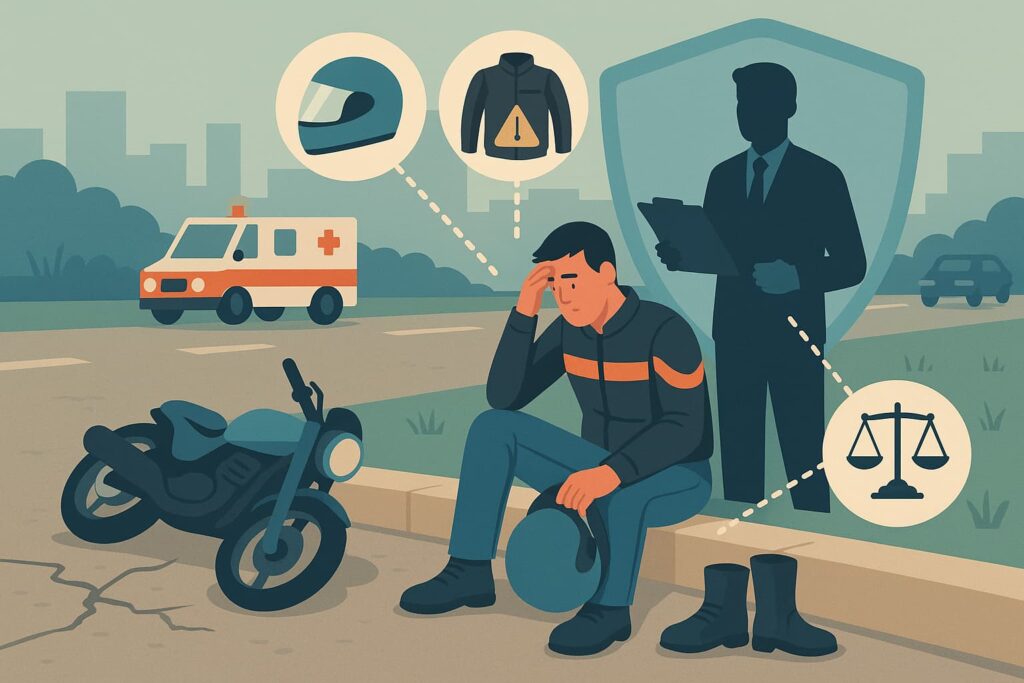
After a collision, one of the first questions an insurance company asks is about your helmet. They want to know if you wore one and what kind it was. This information helps them start building their side of the case.
State laws about helmets vary, which adds a layer of complexity. Some states have universal helmet laws. Other states have laws that apply only to certain riders, like those under a specific age. An insurance adjuster will use your state's specific law to determine your claim.
A personal injury lawyer understands the nuances of state laws and can determine how your insurers will look at your case.
The Legal Side of Not Wearing a Helmet in a Crash
If an accident injured you, an insurance company may argue that not wearing a helmet contributed to your head injuries. They use this argument to try to pay less. This is a strategy, but it’s not always successful.
The insurance company must prove that your lack of a helmet directly caused or worsened your specific injuries. For instance, if you suffered a severe leg injury, your helmet use is irrelevant to that part of your claim. They can’t use a helmet argument to reduce compensation for an unrelated injury.
The legal concept of comparative negligence often comes into play here. It means that if you’re found partially at fault for your own injuries, your compensation may be reduced. Not wearing a helmet is sometimes viewed as a form of negligence by the rider.
When Your Helmet Was Not DOT-Approved
Wearing a helmet that doesn't meet Department of Transportation (DOT) standards is another point an adjuster might focus on. Insurance companies may treat a non-compliant helmet the same as wearing no helmet at all, arguing that it offers inadequate protection.
Your attorney challenges this by focusing on the helmet's actual performance during the crash. A helmet, even a non-DOT one, may have lessened the impact. The focus remains on what caused the accident in the first place.
Protective Gear’s Role in Your Legal Claim After a Crash
Protective jackets, pants, boots, and gloves also play a role in what protective gear can and can’t protect you legally after a motorcycle crash. While states rarely mandate this type of gear for adult riders, insurance companies still look at it.
They may suggest that better gear might have prevented or reduced your injuries. They use this as a tactic to shift blame. An insurance adjuster might imply that you accepted a greater risk by not wearing full gear.
Your legal team counters this tactic by keeping the focus on the person who caused the accident. Your clothing choices don't give another driver a license to be reckless.
Riding Jackets and Pants in a Legal Claim
If you suffered road rash, broken bones, or other injuries to your torso or limbs, an adjuster might question your clothing. They could suggest that specialized riding pants or an armored jacket might have resulted in less severe injuries. This is a common strategy in motorcycle accident claims.
This argument attempts to assign you partial fault for the severity of your injuries. A lawyer fights back by showing that the force of the accident was the primary cause of the harm. Even the best gear has limits, and it's not designed to withstand the full impact of a car or truck.
Here are some points an attorney might make about your gear:
- Focus on Causation: Your lawyer will argue that the other driver’s negligence caused the crash itself, which is the root of all injuries.
- Gear Limitations: They might show that, given the speed and angle of the impact, the injuries would have occurred even with the most advanced gear.
- Injury Specifics: The legal team will connect specific injuries directly to the crash dynamics, not your apparel choices.
Your choice of a t-shirt instead of a leather jacket doesn’t make you responsible for a driver who ran a red light.
How Boots and Gloves Influence Your Case
The same logic applies to your hands and feet. An insurance company may look at injuries to these areas and question your choice of footwear or gloves. They may try to connect your injuries to your lack of specific motorcycle gear.
These are often smaller pieces of a larger claim, but are part of the insurance company’s strategy to minimize its payout. Your legal counsel's job is to prevent them from using these minor points to distract from the main issue. The main issue is the liability of the at-fault driver.
What Matters Most After a Motorcycle Crash: Negligence
The core of your motorcycle accident claim is the other driver’s negligence. This legal term simply means that another person failed to act with reasonable care, and their carelessness caused the accident that injured you. Arguments about your gear are a distraction from this central fact.
An at-fault driver breaks a traffic law or simply fails to pay attention. Their actions, not your jacket or boots, set the crash in motion, and the law holds them accountable for the consequences of that failure.
Common examples of driver negligence in motorcycle accidents include:
- Distracted Driving: A driver was texting, talking on the phone, or adjusting their radio and didn’t see you.
- Failing To Yield: A car turned left in front of you at an intersection, violating your right-of-way.
- Unsafe Lane Changes: A driver swerved into your lane without checking their blind spot or using a signal.
- Driving Under the Influence: The person who hit you was impaired by alcohol or drugs.
- Speeding or Tailgating: The driver was going too fast or following you too closely, leaving no room to stop.
These careless actions are what cause crashes. Your lawyer builds the entire case around proving that the other driver’s negligence was the true cause of your injuries.
The Insurance Company’s Overarching Strategy: Comparative Negligence
Insurance companies frequently use the legal doctrine of comparative negligence to reduce the value of motorcycle injury claims. The goal is to assign a percentage of fault to you, the injured rider. Any percentage of fault assigned to you reduces the compensation you can receive.
For example, if you’re found 10% at fault for your injuries, your final compensation award is reduced by 10%. In some states, if your fault percentage is high enough, you can’t receive compensation at all.
The adjuster’s questions about your helmet, jacket, and boots are all designed to build a case for your partial fault. They want to create a narrative that you didn’t do enough to protect yourself.
The way comparative negligence works differs by state:
- Modified Comparative Negligence (51% Bar): In states like Pennsylvania, Massachusetts, and Florida, you can recover damages if your fault doesn’t exceed 50%. If you are 51% or more at fault, you get nothing.
- Modified Comparative Negligence (50% Bar): Some states cap fault percentage at 50% for compensation.
- Pure Comparative Negligence: In some states, you can recover damages even if you are 99% at fault. Your percentage of fault just reduces your compensation.
An attorney who understands these state-specific rules protects you from unfair blame. They know how to challenge the insurance company’s arguments.
The Battle Against Unfair Blame
An adjuster is trained to ask questions that might lead you to admit some degree of fault. They may ask about your speed, your position in the lane, or what you were wearing in a way that implies you were doing something wrong.
You don't have to fight this battle alone. Having a professional on your side levels the playing field. It sends a message to the insurance company that you won’t accept an unfair offer based on flimsy arguments about your gear.
How a Lawyer Helps With Your Motorcycle Accident Claim
A lawyer manages every aspect of your case so you can focus on your recovery. They navigate the complex legal system for you, acting as your guide and advocate at every turn.
Investigating the Crash Thoroughly
Your attorney gathers all the evidence related to the crash. This includes the police report, photos of the scene, and witness contact information. They may also hire accident reconstruction experts to prove how the other driver was at fault.
Calculating Your Total Losses
A lawyer calculates the full extent of your damages. This is more than just your immediate medical bills. It includes future medical care, lost wages, loss of future earning capacity, and pain and suffering.
Handling Communications
Your lawyer takes over all communication with the insurance companies and opposing counsel. You no longer have to deal with adjusters trying to get you to say something that could hurt your case. This protects you from their tactics and lets your lawyer control the narrative.
Negotiating a Fair Settlement
An experienced attorney knows how much a case like yours is worth. They use the evidence gathered to negotiate aggressively with the insurance company for a fair settlement. Your lawyer won’t let the adjuster undervalue your claim based on arguments about your protective gear.
Taking Your Case to Court
If the insurance company refuses to make a fair offer, your lawyer can file a lawsuit and fight for you in court. Having a trial-ready attorney on your side often motivates the insurance company to offer a better settlement.
FAQ for What Protective Gear Can and Can’t Protect You Legally After a Motorcycle Crash?
Does Failing To Wear a Helmet Automatically Ruin My Case?
No, failing to wear a helmet doesn’t automatically ruin your case. An insurance company may try to argue you were negligent, but the other driver's responsibility for causing the crash is the main focus.
Your lawyer will work to show that the other party’s actions led to the accident, regardless of your helmet use.
Can the Other Driver Argue My Injuries Are My Fault Because of My Gear?
The other driver's legal team or their insurer might make this argument, but it’s a defense tactic. They must prove that your choice of gear, or lack thereof, directly worsened your injuries.
A skilled attorney will counter this by demonstrating that the crash impact, not your apparel, was the primary cause of your harm.
What Protective Gear Legally Impacts My Claim the Most After a Motorcycle Crash?
Your helmet is the piece of protective gear that has the biggest legal impact on your claim after a motorcycle crash. This is because many states have specific helmet laws, and head injuries often result in high-value claims.
Insurance companies focus heavily on helmet use to try to apply comparative negligence and reduce their payout.
How Does the Type of Helmet I Wore Affect My Claim?
If you weren’t wearing a DOT-approved helmet, it might lead the insurance company to argue it was insufficient protection, similar to wearing no helmet. However, the helmet's performance in the actual crash matters.
Your attorney can argue that any helmet is better than none and still helped reduce the overall force of the impact.
Do I Have a Case if I Didn’t Wear Any Protective Gear?
Yes, you likely still have a case even if you weren’t wearing protective gear. The fault for causing the accident is the foundation of a personal injury claim.
While the insurance company will almost certainly raise the issue of your gear to reduce your compensation, it doesn’t erase the other driver's liability for causing the crash in the first place.
Forge a Path Forward
The legal system has complexities that are tough to navigate alone, especially when you’re up against powerful insurance companies. Taking action to protect your rights is a sign of strength. The Oakes Firm is ready to stand by your side.
We build a shield around our clients, handling every legal detail. Our Philadelphia, Miami, and Boston attorneys are ready to fight for you. Call us today at (267) 310-0656 for a free consultation.