A commercial truck hitting your car isn't just a fender bender scaled up. In one recent year, large trucks were involved in crashes that killed over 4,800 people in the U.S. And when people survive, the injuries can be devastating, leading to long-term pain, astronomical medical bills, and a life turned upside down.
So, while there's no magic average number, understanding what actually does affect your potential settlement is key. If a truck accident messed up your life, figuring out what comes next is priority number one. Let's get into what matters.
Call a truck accident lawyer from The Oakes Firm at (267) 310-0656 to talk about your specific situation.
Schedule A Free Case Consultation
Forget "Average": Why It Doesn't Apply Here
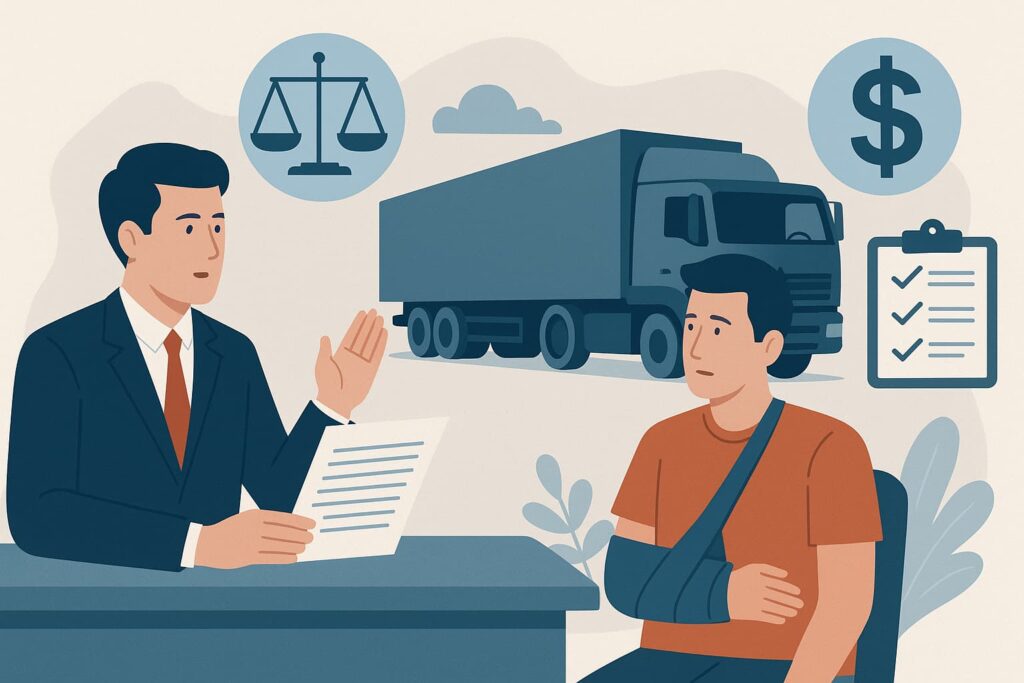
Chasing an "average truck accident settlement amount" is a recipe for frustration. You might see figures ranging from $100,000 to millions, but these numbers are pulled from wildly different scenarios. One case might involve relatively minor injuries settled quickly; another might involve a multi-million dollar verdict after a trial for catastrophic injuries or a fatality. Lumping them together creates an "average" that means absolutely nothing for your unique situation.
Think about it: was the truck driver blatantly negligent? Were your injuries relatively minor, or did they change your life forever? Was the trucking company cutting corners on safety? Did multiple parties share blame?
These variables swing the potential settlement value dramatically. Various sources state settlements can range from a few thousand to several million dollars. Focusing on averages ignores the specific details that will actually determine the outcome of your claim. It's misleading and sets unrealistic expectations, either too high or too low.
So, let's ditch the average and look at the real drivers of settlement value.
The Nitty-Gritty: Factors That Actually Determine Your Settlement
How Badly Were You Hurt? (Severity of Injuries)
This is usually the biggest driver of value. It makes sense: more severe injuries mean higher medical bills, more pain, longer recovery times, and a greater impact on your life.
- Medical Expenses (Past and Future): This includes everything from the ambulance ride and initial ER visit to surgeries, hospital stays, medications, physical therapy, rehabilitation, and assistive devices (wheelchairs, prosthetics). If your injuries require long-term or lifelong care, the projected future costs are a major component.
- Type of Injuries: A case involving whiplash and bruising will look very different from one involving spinal cord damage, traumatic brain injury (TBI), amputations, or severe burns. Catastrophic injuries requiring permanent care naturally lead to much higher settlement values.
- Long-Term Impact: Will you have permanent disabilities? Chronic pain? Will you need modifications to your home or vehicle? Can you ever return to your previous job or hobbies? The answers significantly affect the compensation needed.
The Measurable Losses (Economic Damages)
These are the damages that usually come with clear price tags attached. They are the direct financial hits you've taken because of the accident.
- Lost Wages: This covers the income you lost while recovering.
- Loss of Earning Capacity: If your injuries prevent you from returning to your previous job or limit your ability to earn money in the future, this calculation estimates the lifetime financial impact. This is particularly significant for younger individuals with severe, permanent injuries.
- Property Damage: This typically covers the repair or replacement cost of your vehicle and any other property damaged in the crash.
- Other Out-of-Pocket Costs: This can include things like transportation to medical appointments, hiring help for household chores you can no longer do, or modifications needed for accessibility.
The Harder-to-Measure Losses (Non-Economic Damages)
These damages compensate you for the intangible, but very real, consequences of the accident. They are subjective and harder to assign a dollar value to, often becoming significant points of negotiation.
- Pain and Suffering: Compensation for the physical pain and discomfort caused by your injuries.
- Emotional Distress/Mental Anguish: Covers psychological impacts like anxiety, depression, fear, insomnia, or PTSD resulting from the trauma of the accident and its aftermath.
- Loss of Enjoyment of Life: Compensation for the inability to participate in hobbies, activities, and life experiences you previously enjoyed.
- Loss of Consortium: This is a claim that potentially can be brought by the spouse (or sometimes other close family members) of the injured person for the loss of companionship, affection, support, and intimacy resulting from the injuries.
- Disfigurement/Scarring: Compensation for permanent physical changes that affect appearance.
In Pennsylvania, there's generally no legal cap on the amount of non-economic damages you can recover in a personal injury case like a truck accident. However, calculating these damages involves assessing the severity and permanence of your suffering, which requires careful presentation of evidence.
Who Messed Up and How Much? (Liability and Negligence)
Figuring out who caused the accident is fundamental. In truck crashes, it's not always just the driver. Liability can potentially fall on:
- The truck driver (speeding, fatigue, distraction, impairment, violating traffic laws).
- The trucking company (negligent hiring, poor training, inadequate maintenance, pressure to violate hours-of-service rules).
- The truck manufacturer (defective parts like brakes or tires).
- The cargo loader (improperly secured or overloaded cargo shifting and causing loss of control).
- A maintenance provider (faulty repairs).
Pennsylvania's Rule: Pennsylvania uses a "modified comparative negligence" rule, specifically the 51% bar rule, as detailed in 42 Pa.C.S.A. § 7102(a). Here’s how it works:
- You can recover damages only if your percentage of fault is not greater than the combined fault of the defendant(s) you are suing. In simple terms, you must be 50% or less responsible for the accident.
- If you are found partially at fault (but 50% or less), your total damages award will be reduced by your percentage of fault. For example, if you have $200,000 in damages but are found 10% at fault, your recovery is reduced by $20,000, leaving you with $180,000.
- If you are found 51% or more at fault, you recover nothing.
Trucking companies and their insurers often argue that the injured person shared blame (comparative negligence) to reduce or eliminate their payout. Proving clear liability against the truck driver or company strengthens your negotiating position.
How Much Insurance is Available? (Policy Limits)
No matter how severe your injuries or how clear the liability, the amount of available insurance money often acts as a practical ceiling on settlement amounts.
- FMCSA Minimums: Federal regulations (FMCSA) mandate minimum liability insurance for commercial trucks operating interstate. As of early 2025, these minimums are generally:
- $750,000 for trucks over 10,001 pounds carrying non-hazardous freight.
- $1,000,000 for transporting oil.
- $5,000,000 for transporting other hazardous materials.
- ($300,000 for smaller vehicles under 10,001 lbs carrying non-hazardous freight).
- Higher Limits & Umbrella Policies: Many large trucking companies carry insurance policies well above these minimums, often $1 million, $2 million, or even more. They may also have additional "umbrella" policies that provide extra coverage once the primary policy limit is exhausted.
- Hitting the Limit: In catastrophic cases, damages can easily exceed even high policy limits. Exploring all potential defendants and insurance policies (including your own underinsured motorist coverage, if applicable) becomes necessary.
The Quality of Your Legal Representation
Trucking companies and their insurers have teams dedicated to minimizing payouts. Having a lawyer who understands trucking regulations, knows how to investigate these complex cases, gather critical evidence (like driver logs and electronic data recorder info), and effectively negotiate makes a significant difference. An attorney builds the strongest possible case for your damages and counters the insurance company's tactics.
The Trucking Industry Machine: Why These Cases Are Different
The trucking industry operates under a complex web of federal and state regulations (like FMCSA rules on hours of service, maintenance, driver qualifications, etc.). Proving violations of these regulations can be key evidence of negligence.
Furthermore, trucking companies and their insurers are notorious for deploying rapid response teams to accident scenes. Their goal is to control the narrative and gather evidence that favors them. They often employ aggressive defense strategies, such as:
- Blaming the Victim: Arguing you were partially or fully at fault (comparative negligence).
- Denying Negligence: Claiming the driver did nothing wrong or faced a sudden emergency.
- Questioning Injuries: Suggesting your injuries existed before the crash or aren't as severe as claimed.
- Challenging Evidence: Disputing the accuracy or reliability of your evidence.
- Delay Tactics: Drawing out the process hoping you'll accept a lowball offer out of frustration or financial desperation.
Preserving crucial evidence unique to trucks – like the truck's electronic data recorder ("black box"), driver logs, dispatch records, maintenance history, and post-accident drug/alcohol tests – is imperative, and it needs to happen quickly before it "disappears."
Schedule A Free Case Consultation
After the Dust Settles: Your Next Moves (Starting From Home)
You're home, likely sore, stressed, and wondering what happens now. Here’s a practical checklist:
- Keep Up With Medical Treatment: Follow your doctor's advice to the letter. Attend every appointment, therapy session, and follow-up. This not only helps your physical recovery but also creates a clear medical record documenting your injuries and their impact. Gaps in treatment can be used by insurers to argue your injuries weren't serious.
- Become a Record-Keeping Machine: Start a folder (physical or digital) immediately. Keep everything:
- Medical bills, explanation of benefits (EOBs) from your health insurer.
- Receipts for prescriptions, co-pays, medical devices.
- Your vehicle repair estimates or replacement valuation.
- Records of lost work time (pay stubs showing reduced hours or time off).
- Any correspondence with insurance companies (yours and theirs).
- A simple journal detailing your pain levels, limitations on daily activities, sleep disturbances, emotional state, and how the injuries affect your life. This helps document your non-economic damages.
- Inform Your Own Insurance Company: Report the accident factually. Provide the date, time, location, and involved parties. Avoid guessing about fault or giving lengthy recorded statements without advice.
- Resist the Quick Settlement Trap: The trucking company's insurer might contact you quickly, seem sympathetic, and even offer a settlement. Be very wary. These initial offers are almost always lowball amounts designed to make the claim go away cheaply before you fully understand the extent of your injuries and future needs. Do not sign anything or accept payment without consulting an attorney.
- Go Dark on Social Media: Assume insurance adjusters are looking. Avoid posting about the accident, your injuries, your recovery, or activities that could be misconstrued (like photos of you smiling at an event, which they might use to argue you aren't really suffering). It's best to pause social media activity or set profiles to private.
- Talk to a Lawyer: An attorney will protect your rights, handle communication with aggressive insurers, investigate the crash thoroughly (including preserving that critical truck evidence), calculate your full damages (present and future), and negotiate for fair compensation.
What Might a Settlement Look Like? (Illustrative Examples Only)
Since averages are useless, let's consider hypothetical scenarios to see how factors interact. Remember, these are just simplified examples, not predictions or guarantees for your case.
- Scenario 1: Moderate Injuries, Clear Fault, Good Insurance. Imagine a truck runs a red light, causing a collision. You suffer a broken arm and whiplash, requiring ER treatment, follow-up care, physical therapy, and several weeks off work. Liability is clearly on the truck driver. The trucking company has a $1 million policy. Your economic damages (medical bills, lost wages) total $25,000. Your non-economic damages (pain, suffering, temporary limitations) are assessed. A settlement might fall in the range of, say, $75,000 - $150,000, reflecting the economic losses plus significant compensation for pain and temporary life disruption.
- Scenario 2: Severe Injuries, Disputed Fault, High Insurance. A truck merges improperly on the highway, sideswiping your car and causing a rollover. You sustain a serious back injury requiring surgery and leaving you with chronic pain and permanent limitations, preventing you from returning to your physically demanding job. Damages are extensive: significant past/future medical costs, major loss of earning capacity, substantial pain and suffering. However, the trucking company argues you were speeding or didn't take evasive action, trying to place 30% fault on you using Pennsylvania's comparative negligence rule. The company has a $2 million policy. Proving the full extent of damages and fighting the liability dispute is key. If total damages are valued at $1.5 million, but you're ultimately found 20% at fault, the recovery would be $1.2 million. If fault is heavily disputed, the case might go to trial or settle for a compromise amount reflecting the litigation risk for both sides, potentially anywhere from $500,000 to over $1 million depending on evidence strength and negotiation.
These examples show how dramatically the outcomes change based on the unique facts. Your specific injuries, the evidence of fault, the insurance available, and how effectively your case is presented dictate the final number.
Don't Settle for Average: Secure the Compensation You Need
Trucking companies have powerful resources aimed at paying as little as possible. Don't let them dictate the value of your recovery.
Take control of your claim. Call an experienced personal injury lawyer from The Oakes Firm today at (267) 310-0656 for a consultation focused on getting you the full compensation you rightfully deserve.